Community
What's the Right Group Size When Forming a Squad?
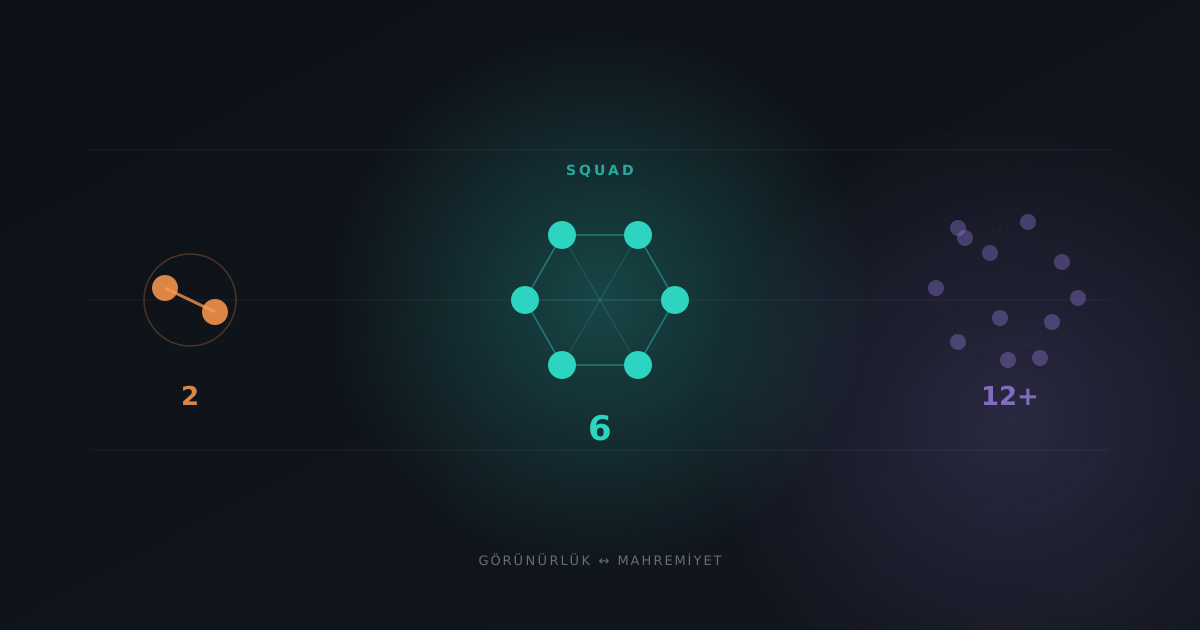
Group size isn’t an arbitrary setting on an accountability feature — a pair and a forty-person chat break the same mechanism in opposite ways. In a pair, one person stepping back leaves nobody to answer to. In a forty-person group, a single missed day disappears into the noise before anyone connects it to a name. Cookrange doesn’t enforce a hard size limit on a squad, but the recommended range sits around six people — less a magic constant than a deliberate landing point between those two failure modes.
Why does group size shape accountability at all?
For accountability to function, two things have to be true at once: someone has to actually notice a gap, and that noticing has to register as support rather than pressure. Group size is the single dial that sets both of these simultaneously. Making a group bigger doesn’t automatically make it more visible — it tends to do the opposite, because once it’s unclear exactly who’s tracking whom, it becomes easy for everyone to assume somebody else already noticed.
Put concretely: in a group of around six, one member skipping a Wednesday workout creates a gap that shows up immediately against the other columns in the same view. The same missed day inside a thirty-person group would likely sit unnoticed in a list nobody’s specifically watching — because at thirty people, the feeling of “this one is mine to track” fades once it’s no longer clear who’s actually responsible for noticing whom.
Why does responsibility thin out in larger groups?
This isn’t a new observation. Ingham, Levinger, Graves, and Peckham’s 1974 replication of Ringelmann’s original 1913 rope-pulling experiment found that individual effort, measured as a share of what the same person produced working alone, dropped steadily as group size grew — to roughly 91% of solo output in pairs, 82% in trios, and about 78% in groups of six. Pulling a rope and noticing a friend’s flattened streak aren’t the same act, but the underlying mechanism matches: the more people a task gets spread across, the smaller each person’s felt share of responsibility for it becomes.
Why does cohesion measure higher in smaller groups?
There’s research pointing the other way, too. Widmeyer, Brawley, and Carron’s 1990 study, published in the Journal of Sport and Exercise Psychology, compared recreational 3-on-3 basketball leagues run with rosters of 3, 6, and 9 players. As roster size grew, both enjoyment and group cohesion declined, while reported crowding increased. That’s a finding about competitive team sport, not asynchronous daily accountability, so it doesn’t transfer one-to-one — but the direction matches a pattern that shows up repeatedly across group-size research: smaller groups consistently produce tighter cohesion than larger ones.
Does that mean smaller is always better?
Not quite — a group that’s too small carries its own cost. In a group of two or three, accountability collapses onto a single relationship: if the other person goes quiet for a week, or leaves altogether, there’s nobody left to answer to. There’s a subtler cost too — knowing that exactly one other person is watching your day, every day, can start to feel less like shared support and more like one-on-one surveillance, which is precisely the pressure accountability is supposed to avoid.
Where does the balance between visibility and privacy actually sit?
Laying the two extremes side by side makes the trade-off easier to see:
| Group size | Visibility of a gap | If one person leaves | Sense of responsibility |
|---|---|---|---|
| 2-3 people | Maximum — impossible to miss | The mechanism largely collapses | Intense, can tip into pressure |
| 5-7 people | High — still stands out | The group holds | Shared, sustainable |
| 10+ people | Low — blends into the crowd | Barely registers | Diluted — “someone else noticed” |
Why does Cookrange recommend six as a squad size?
In Cookrange, a squad has no built-in member limit — you can form one with as many people as you want, each rendered as a column next to the others in the same view. But the absence of a platform-enforced cap doesn’t make the research above irrelevant: six sits close to where the two bodies of research above intersect: large enough that the group can absorb one member going quiet for a stretch without the mechanism collapsing, small enough that a flattened column still can’t hide from the rest. That’s not a number the research dictates outright, and it’s not a limit the app imposes either — it’s a recommendation consistent with what both point toward.
What happens to the mechanism when a member leaves?
The real test of a squad sized around six shows up when someone actually leaves the group, or goes quiet for an extended stretch. In a pair or a trio, that means the mechanism stops entirely. In a squad that drops from six to five, the remaining members keep seeing each other just fine — what changes is simply who’s currently shown as active. A squad doesn’t reset or dissolve on its own; it shrinks and keeps working. That resilience is the concrete reason a group sized around six holds up better over time than a two- or three-person one.
Frequently asked questions
Can I make a squad bigger than six? Yes — there’s no hard limit on squad size. Six is a recommendation, not a cap, based on the pattern of visibility and responsibility thinning out as groups grow larger. If what you’re after is a bigger community experience rather than tight daily accountability, a larger group may serve that goal better than a small squad would.
Is it a problem to form a squad with just two or three people? Not necessarily, but it carries its own risk: the smaller the group, the more one person leaving destabilizes it. In a two-person squad, if either side goes quiet for a while, there’s almost nothing left in terms of accountability.
What’s the difference between squad size and a gym leaderboard? A gym leaderboard is public and compares a large group; a squad operates in a small, private circle. One is a performance ranking, the other an accountability mechanism — they’re not serving the same purpose, so there’s no reason to expect them to be the same size.
Squad size isn’t about landing on the right number for its own sake — it’s about deliberately balancing visibility against privacy. Cookrange is currently in v0.9.6 internal alpha; anyone who wants to try the squad feature early can join the waitlist.