Community
For Coaches: Progress Tracking Without Sharing Athlete Data
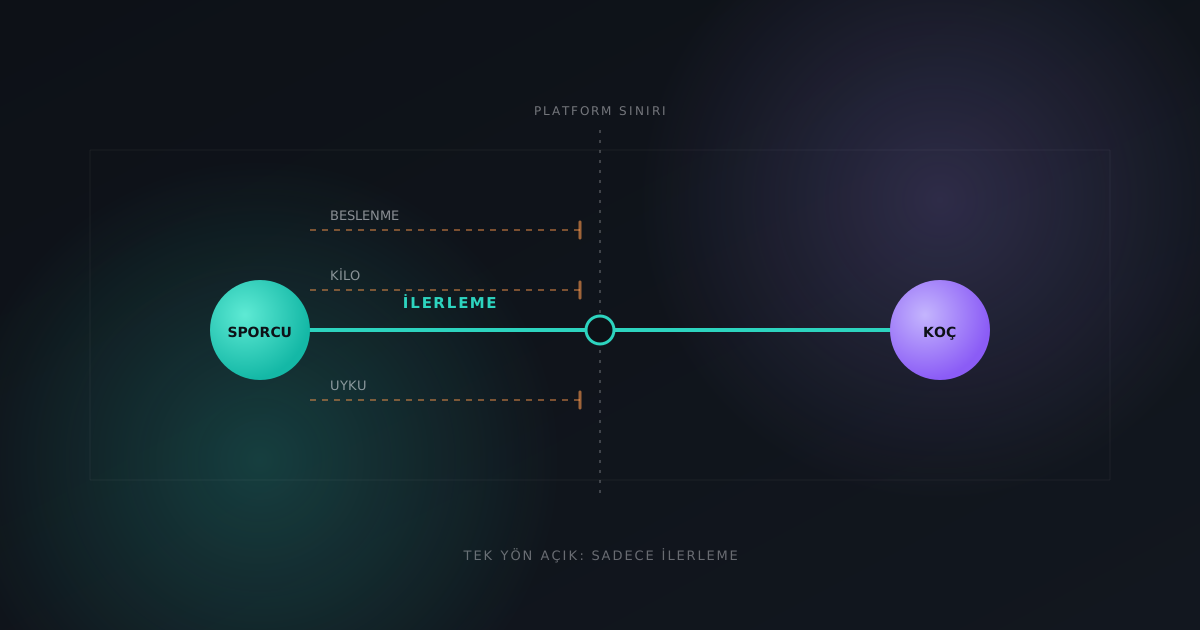
What a coach actually needs from an athlete is whether their training adherence has slipped over the last three weeks — not exactly what they ate on Tuesday night. That distinction sounds minor, but it’s exactly where the line sits that decides whether a coaching relationship can scale without treating an athlete’s full history as a side benefit.
What does a coach actually need to see?
The information a coaching relationship runs on is a narrower band than it first appears. Is the athlete’s progress trend climbing, flat, or slipping; has logging consistency held steady or started to fray in recent weeks; how close is actual training frequency to the target. All of that is a trend question — “what’s happening” — not a “what exactly happened” question. The signal that actually changes what a coach does is something like “logging frequency dropped from 70% to 35% over two weeks” — that’s what tells a coach where to step in. The same underlying record described on progress analytics applies here: a coach reads that record for their own athlete, not every individual entry beneath it.
What a coach doesn’t need
The mirror question matters just as much: does a coach actually need every meal photo, every barcode scan, or exact sleep timestamps? In most coaching relationships, no — that level of detail doesn’t change a coaching decision, but it does make the athlete’s life considerably more exposed than it needs to be. This isn’t just a design preference. The EU’s GDPR requires personal data to be “adequate, relevant and limited to what is necessary” for the purpose it’s processed for — the data minimisation principle set out in Article 5 — and Turkey’s KVKK states the same requirement in Article 4, describing data as needing to be “linked to, limited, and proportionate to the purpose for which it’s processed”; the Turkish Data Protection Authority’s own guidance treats processing more data than a stated purpose requires as a violation of that principle in its own right. A coaching system that opens an athlete’s entire history by default isn’t just an aggressive design choice — it’s the kind of thing data protection law is specifically built to restrict.
What draws the line at the platform level
That distinction stops being a mission statement and becomes an actual boundary through one rule enforced at the platform level: when an athlete explicitly connects a coach to their own account, that coach can read only that athlete’s progress data — not even another athlete the same coach also works with. The athlete is the one who initiates the connection; the coach has no access at all before that consent exists. It’s the same architectural principle as a gym seeing only its own aggregate occupancy, or a squad only seeing each other’s streak status: access is shaped by a relationship that already exists in real life, and it doesn’t reach past the edges of it.
Unrestricted access vs. athlete-approved, scoped access
| Dimension | Unrestricted access model | Athlete-approved, scoped access |
|---|---|---|
| Who initiates access | The coach or an admin panel, unilaterally | The athlete, through their own consent |
| What the coach sees | Nutrition history, body measurements, every detail | Only the progress trend and adherence pattern |
| Access to other athletes | Usually no separation within the same panel | Only the specific athlete who connected, one at a time |
| Future of the connection | Usually unclear, dependent on admin discretion | The athlete can end the connection whenever they choose |
| Scalability | Capped by manual spreadsheets or screenshots | Not capped by the tracking method itself |
Why the boundary works for both sides
The value of a professional having a structured feed of a client’s progress has been studied directly — just not in sports coaching. In psychotherapy, Lambert, Whipple, and Kleinstäuber’s 2018 meta-analysis of routine outcome monitoring found that in two-thirds of the 24 studies reviewed, practitioners receiving structured progress feedback outperformed the same practitioners’ standard practice without it; for clients predicted to have a poor outcome, that feedback reduced deterioration rates and nearly doubled the rate of clinically significant improvement. That’s not a finding that generalizes directly to sports coaching, but the underlying mechanism is the same one: a professional being able to see a trend is meaningfully less invasive than seeing a client’s full raw history, and it’s still enough to inform a real decision. The athlete gains something too — when what’s shared is scoped to exactly what coaching requires, starting to work with a coach doesn’t mean handing your entire history to another person.
How to join Cookrange as a coach
Cookrange is currently at v0.9.6 internal alpha, built by a single founder, and there’s no separate, self-serve signup flow for coaches yet. The Cookrange for coaches page describes this approach and its boundaries in more detail; if you want to try working with your own athletes this way, the most direct path is reaching out through the contact page.
Frequently asked questions
Can a coach see an athlete’s nutrition history or barcode logs? No. Once a connection is established, a coach reads only the progress trend and adherence pattern — meal logs, barcode history, and body measurements stay outside that view.
Can an athlete stop sharing with a coach whenever they want? Since the athlete is the one who initiates the connection, keeping control over ending it is the expected design principle — the site applies the same logic to its other opt-in visibility features, like gym check-in notifications, which are described as something a user can turn off.
How many athletes can one coach track this way at once? There’s no numeric cap stated on the site. What changes is the low ceiling that manual spreadsheets or screenshots naturally impose — since each athlete connects individually, the limiting factor becomes the coach’s own capacity, not the system.
Where to start
Cookrange is currently at v0.9.6 internal alpha, and there’s no separate, scaled program for coaches announced yet. If you want to try working with your own athletes within these boundaries, the most direct step is reaching out through the contact page.