Community
Squad or Solo: Which Personality Type Fits Which?
Keeping a goal somewhere other people can see it is extra fuel for some people and extra pressure for others. That split doesn’t come down to discipline or willpower — it comes down to where the motivation is coming from in the first place, and that’s a distinction psychology has studied for decades.
What’s the difference between extrinsic and intrinsic motivation?
Intrinsic motivation is doing something for its own sake — training because it feels good in the moment, logging because watching progress accumulate is satisfying on its own. Extrinsic motivation is doing something for an outcome separate from the activity itself — looking consistent to other people, avoiding the discomfort of a blank streak column, keeping a commitment made to a group. Teixeira and colleagues’ 2012 systematic review, published in the International Journal of Behavioral Nutrition and Physical Activity, examined 66 separate studies and found that autonomous motivation — regulating a behavior because you’ve internalized it or genuinely enjoy it — was the most consistent predictor of sticking with physical activity. That doesn’t mean extrinsic motivation is useless; it means that on its own, it’s the more fragile of the two.
There’s an important middle category here: most people’s day-to-day motivation to train or log isn’t purely intrinsic or purely extrinsic — it sits in an “identified” middle zone, where the behavior isn’t necessarily fun in the moment but gets sustained because the outcome is valued. That middle zone is where a squad tends to operate safely; the case where it’s genuinely risky is the much narrower one of someone who already finds the behavior enjoyable purely for its own sake.
When does a squad genuinely help?
This is exactly what a squad adds: an extrinsic component layered onto the behavior. For someone who isn’t purely intrinsically driven already, but for whom knowing “someone could see this” makes a small difference, that addition is a real contribution — knowing a flattened column will go unnoticed makes it cheaper to skip a day, and knowing someone will notice brings that cost back. This isn’t about weak willpower; it works because part of the motivation was already coming from social visibility in the first place. Take someone whose goal is three workouts a week and who quietly lets that slide to one or two whenever nobody’s watching — knowing a squad will notice makes skipping the third workout cost something again.
When does a squad add nothing, or actively backfire?
There are two situations where a squad creates friction instead of help. The first is someone who already does the behavior entirely for its own sake: Deci, Koestner and Ryan’s 1999 meta-analysis, published in Psychological Bulletin, reviewed 128 experiments and found that external rewards and controlling elements, when added to a behavior people were already intrinsically interested in, measurably reduced how intrinsically interesting that behavior stayed afterward. That finding isn’t a direct study of squads specifically, but the same logic applies: making something you already do for its own sake visible and “watched” can make it feel a little less self-directed for some people. The second situation is someone who finds shared visibility stressful rather than motivating — that’s not a personality flaw, it’s a genuine difference in what people respond to, and for this person a squad produces extra anxiety rather than extra benefit.
How do you tell which one you are?
There’s a simple way to check which category you lean toward: think back to a group challenge or a shared leaderboard you’ve taken part in before. Did being visible make you more consistent, or did it take the edge off your actual interest in the activity? If it’s the former, the extrinsic layer a squad adds is probably working in your favor; if it’s the latter, tracking that same goal without visibility is probably the better starting point. This isn’t a question that needs a single right answer up front — it’s a pattern that shows up after a few weeks of paying attention.
Hybrid use: both at once
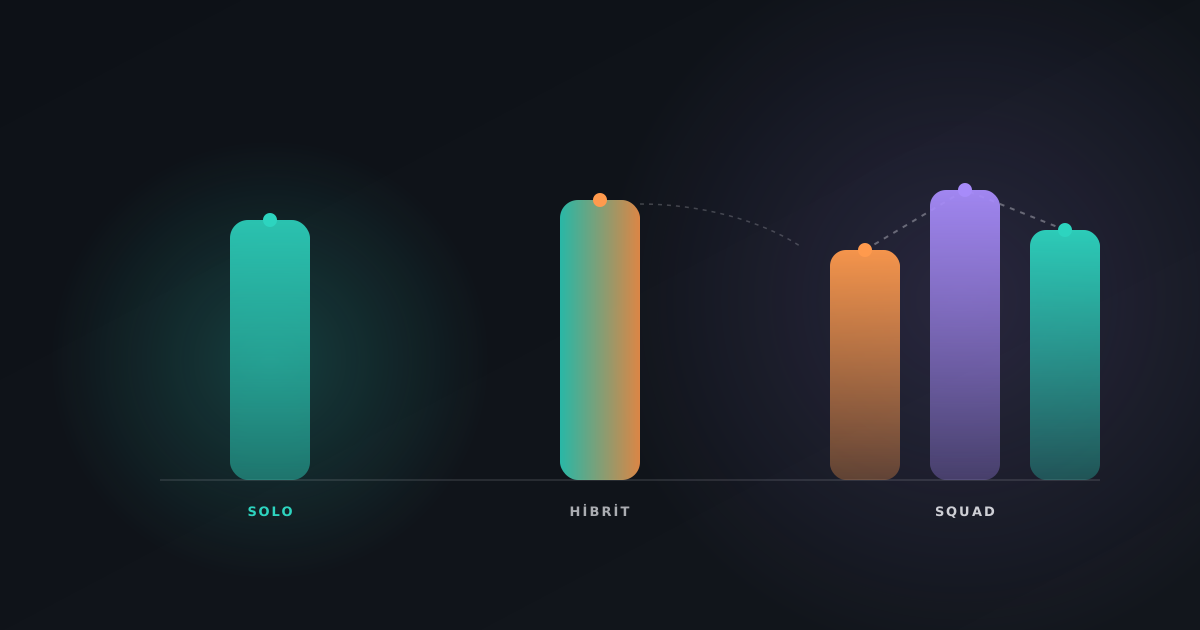
Squad and solo tracking aren’t mutually exclusive. Someone might share a weekly workout goal with a squad while keeping nutrition logs entirely private; someone else might prefer the opposite split. Or someone might try a squad for the first few weeks specifically to see how they react to it — sticking with it if it feels supportive, quietly moving that one goal back to solo if it starts feeling like pressure instead. That’s not a decision made once and locked in. In Cookrange, a squad is an optional layer added on top of core logging and planning — the entire app works without ever joining community & squads, and how that layer connects to the rest of the app is covered on the how it works page. So the more useful question isn’t “squad or solo” — it’s “which one for which goal.”
Fit by personality tendency
| Criterion | Leans toward squad | Leans toward solo |
|---|---|---|
| Source of motivation | Partly extrinsic / social expectation | Largely intrinsic |
| Feeling of shared visibility | Supportive, lightens the load | Feels like pressure |
| Reaction to a gap day | Someone else noticing helps | Noticing it yourself is already enough |
| Best-fit use case | A shared goal (e.g. weekly workout count) | Personal or sensitive goals (e.g. detailed nutrition logs) |
Frequently asked questions
If I don’t join a squad, do I miss out on Cookrange’s core features? No. A squad is an optional social layer; meal logging, planning, and progress tracking all work fully without ever joining one.
If I’m more of an introvert, is a squad pointless for me? Not necessarily. This isn’t all-or-nothing — sharing just a weekly workout goal with a squad while keeping everything else private is a perfectly reasonable setup.
Can I use a squad and solo tracking at the same time? Yes. Both can run at once for different goals; one doesn’t cancel out the other. Looking at the different profiles on the who it’s for page can help clarify which combination fits.
Where to start
Whether to join a squad isn’t a personality test — it’s a matter of noticing which goals benefit from extrinsic visibility and which ones just pick up unnecessary pressure from it. Cookrange is built to support either choice; join the waitlist for early access.