Progress
The Logic Behind 90-Day Weight Projections
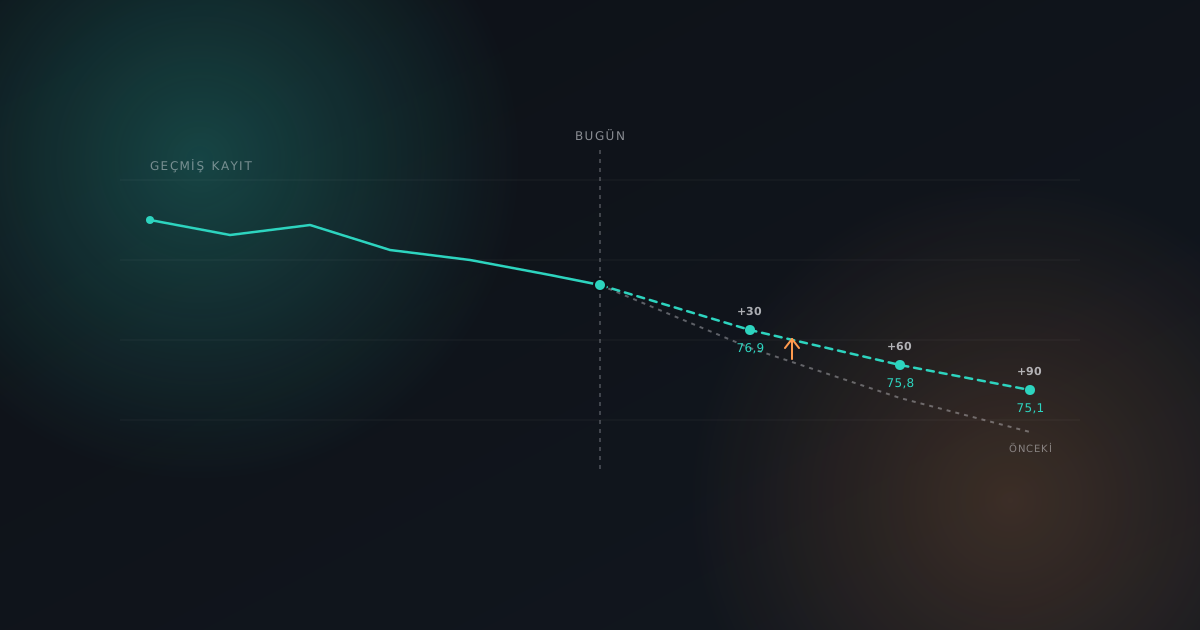
A 90-day projection doesn’t say “you will weigh exactly this in 90 days.” It says “based on the trend in what you’ve actually logged so far, continuing at this rate gets you here.” Say today’s data produces three separate written estimates: around 76.9 kg at +30 days, 75.8 kg at +60, 75.1 kg at +90 — none of those three is “the” answer, and all three carry the same caveat at once: a projection and not a promise.
Why isn’t a projection a promise?
Labeling a projection as an estimate rather than a fact is a design choice, not a hedge tacked on afterward. The historical part of the record reflects what already happened, because it did — a logged trend of past weigh-ins isn’t up for debate. The 30, 60, and 90 days ahead of it haven’t happened yet, so stating them with the same confidence would be misleading. That’s also why three separate estimates get shown instead of one: the +30-day estimate carries less uncertainty than the +90-day one, simply because it covers less time. A single confident number would hide that growing uncertainty; three separate estimates make it visible instead — each one is a projection and not a promise.
What data actually feeds the projection?
The distinction that matters here: the projection isn’t calculated from a generic formula applied the same way to everyone — it’s generated from a person’s own logged trend. Two inputs feed it: training frequency and how consistently someone logs. Raise the weekly training count and the projected pace changes; a week with no logging doesn’t get filled in with a guess about how it probably went — it’s simply treated as a week that ran on thin data, and the estimate is generated from whatever’s actually there.
A concrete comparison makes this clearer. Take two people who are close in age, height, and weight. One has logged training five days a week for the past eight weeks; the other has logged training once a week over the same stretch. A generic formula based on age, height, and weight would hand both of them nearly the same estimate, because its inputs look similar for both. A personal projection produces a completely different estimate for each of them, because its input isn’t age, height, or weight — it’s what actually got logged over those eight weeks.
Why three estimates instead of one date?
The reason a 90-day horizon gets presented as three separate estimates instead of one end date is to make growing uncertainty visible rather than hidden. The +30-day estimate is a relatively close extension of today’s trend, so the margin for error is fairly narrow. The +90-day estimate is the same trend carried much further out, and over that stretch there’s a lot more room for training frequency, logging consistency, or some other input to change. Showing three estimates is a way of saying “the near future is reasonably clear, the far one is more open” instead of claiming a single confident answer for a date three months out.
The 90-day window itself isn’t an arbitrary round number either. A much shorter horizon, say seven days, would mostly reflect day-to-day noise that has nothing to do with actual fat loss — a scale reading moves up and down within a day for reasons like water, sodium, and how much food is physically sitting in the body, which is exactly why the projection is built from a logged trend rather than any single reading. A much longer horizon, say 300 days, runs into the opposite problem: carrying today’s trend out that far stops being a reasonable estimate and starts being speculation. Ninety days sits between those two extremes, in the range where a current trend can still be extended forward and mean something.
Generic formula vs. personal projection
| Criterion | Generic formula | Personal projection |
|---|---|---|
| What it’s based on | Average by age/height/weight/activity | The user’s own logged trend |
| A week with no logging | Doesn’t register — formula stays the same | The estimate reflects that the week ran on thin data |
| When an input changes | Usually stays fixed | Recalculates instantly |
| What it hands back | One average estimate | Three separate written estimates (+30/+60/+90) |
| What it’s for | Setting a general expectation | Extending a person’s own data forward |
Why does the projection update the instant one input changes?
The projection doesn’t run as a separate forecasting engine — it’s generated directly from the same logged history, carried forward as a written estimate rather than a fixed calculation. That’s why changing an input like weekly training frequency updates the projection immediately: what changed isn’t a separate calculation, it’s the data the estimate is generated from. That same philosophy carries over to an adaptive meal plan that can be regenerated against current data instead of staying fixed: both replace a “calculate once, then lock it in” approach with relying on whatever the most current data actually is — the difference is that the projection updates on its own with every new log entry, while the plan’s target only updates when you choose to regenerate it.
A week without logging doesn’t get filled in with a guess here either. The system doesn’t assume “probably continued as normal” on someone’s behalf — it just reflects that the week ran on thin data, and the projection updates again with the next thing logged. With 412 days of history behind someone, the projection is generated directly from those 412 days — not from a separate screen, not from a separate calculation.
The practical upshot is that nothing needs to be manually reset for the projection to stay honest. Training more, picking logging back up, or skipping a week entirely — whichever one happens, the projection updates on its own with the next entry. The only thing that actually falls on the user is to keep logging; everything past that is just the same data, carried forward.
Frequently asked questions
Why not just give one confident estimate instead of three numbers? Because a single number hides uncertainty that actually grows over time. The +30-day estimate carries less uncertainty than the +90-day one; three separate written estimates show that difference honestly, where one “confident” number would claim a certainty that doesn’t exist.
What happens to the projection if I don’t log for a week? The projection doesn’t fill that week in with a guess — it just reflects that the week ran on thin data. As soon as new data comes in, the projection updates around it.
Does the projection guarantee I’ll hit my weight goal? No. That’s exactly what calling it a projection instead of a promise is designed to communicate — it’s today’s trend extended forward, not a guarantee. Change training frequency, logging consistency, or any other input, and the projection changes with it.
Where to start
A projection’s value doesn’t come from handing over one certain number — it comes from being grounded in a person’s own record, and honestly reshaping the moment the underlying data changes. Cookrange’s progress analytics page walks through the full mechanism; anyone who wants early access can join the waitlist.