Comparisons
What to Look for in a MyFitnessPal Alternative
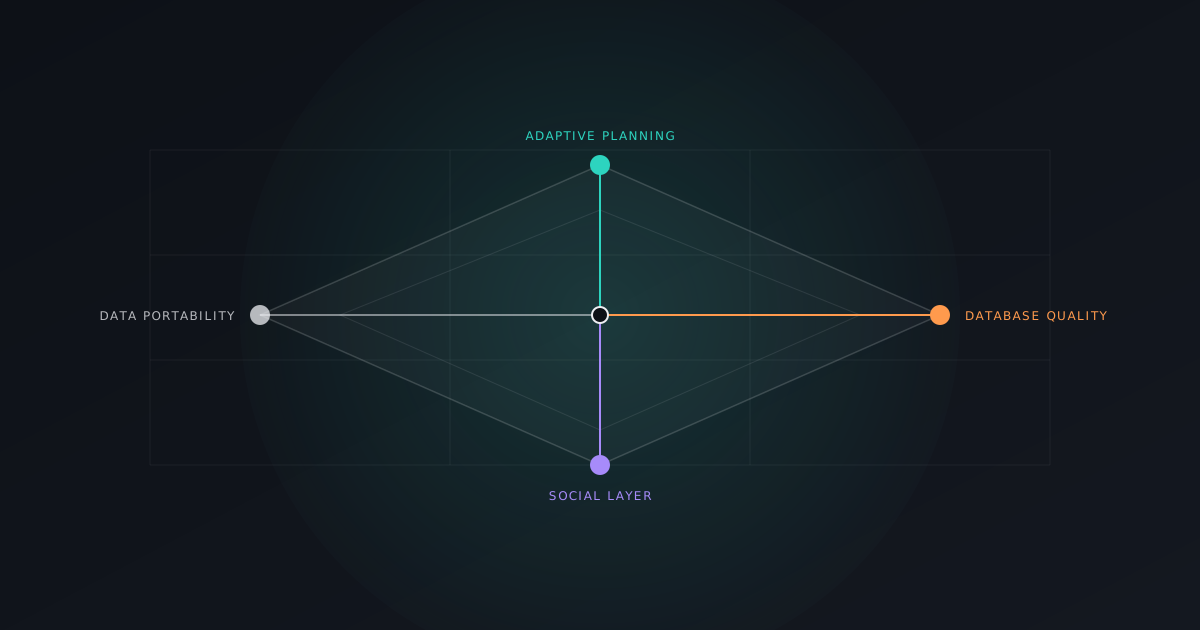
Evaluating an alternative to MyFitnessPal comes down to four concrete criteria: whether the app locks you into a fixed calorie target or shows you calories burned in real time and lets you regenerate that target on demand, how complete and accurate its local food database really is, whether it has a social layer that supports real accountability, and whether your data can be exported or deleted on request. Brand recognition and interface polish don’t answer any of these four questions — but they’re what largely determines whether you’re still using the app in three months.
Why isn’t “most popular” the right question?
The most-downloaded app isn’t necessarily the most accurate one for your specific situation. Popularity generally means broad appeal — which tends to translate into a wide but shallow feature set, a large but variable-quality database, and an experience tuned for an “average user.” You aren’t an average user; you’re someone shopping at specific stores in a specific place, going to a specific gym, and wanting to share a goal with specific people. The right question isn’t “which one is most famous” — it’s “which one actually matches how I live.”
Criterion 1: Fixed target, or an adaptive plan?
The conventional model computes a daily calorie and macro target once and holds it indefinitely. The problem is that real days aren’t that uniform — a long walk one day, a training session the next, a night of bad sleep — all of it changes actual energy needs. An adaptive plan deals with this two ways instead of hiding it: it shows calories burned on top of the day’s target instantly, without the target itself changing, and it lets you regenerate the plan with current data whenever you want — never touching meals already logged. When evaluating an app, ask: does it show you calories burned after an unplanned walk or workout, and can it hand you a new target within seconds when you ask for one — or does all of that land entirely on you?
Criterion 2: How complete and accurate is the local food database?
A barcode scanner’s speed matters less than whether the database recognizes the products you actually buy. Nearly every app recognizes major global brands; the real test is a regional brand, a grocery chain’s private-label product, or a reasonable estimate for loose food and home cooking. There’s direct evidence this varies more than people assume: Griffiths, Harnack, and Pereira’s 2018 study compared nutrient calculations from five popular apps against a reference method and found correlations ranging from 0.73 to 0.96 for energy and macronutrients — meaning popularity is no guarantee of accuracy for the specific item you just logged. Large apps like MyFitnessPal state in their own support documentation that much of their database comes from unverified member submissions — not a flaw exactly, but a design tradeoff worth knowing before you rely on it.
Criterion 3: Is there a real social layer, or a decorative one?
A goal kept entirely alone can quietly lapse without anyone noticing. Wing and Jeffery’s 1999 study found that participants recruited with friends and given a social-support component completed a weight-management program at a 95% rate, versus 76% for those who joined alone — and long-term maintenance was 66% versus 24%. When evaluating an app’s social features, the question isn’t “can I add friends” — it’s whether that layer creates real visibility and accountability, or is just a decorative friends list with no consequence attached to it.
Criterion 4: Can your data leave with you?
Months, possibly years, of logged history shouldn’t be trapped inside one app. Under regimes like the EU’s GDPR (specifically the right to data portability under Article 20) or Turkey’s KVKK, individuals have a legal right to access, correct, and request deletion of their own data — and how an app actually handles that request in practice is a concrete thing to check, not just a legal formality. It’s really a question about three years from now: if you switch platforms, does your history come with you?
Does the pricing model restrict access to your own data?
Alongside the four main criteria, there’s a related question worth asking: what exactly does the paid tier unlock? In some apps, “premium” is what unlocks historical data, export, or even basic charts — meaning a free user can’t fully see their own history. What’s worth checking is whether a paid tier is selling additional capability (more AI-generated plans, deeper analytics) or effectively selling access to data you already generated yourself. That distinction matters more than whether the free tier feels generous enough — it’s really about whether your own historical record is being used as a pricing lever.
Comparing the four criteria
| Criterion | Weak signal | Strong signal |
|---|---|---|
| Planning approach | Target calculated once, never revisited | Calories burned shown on top of the target instantly; target itself regenerated on demand |
| Food database | Only major global brands reliably recognized, frequent “not found” on local items | Local/regional products and loose food get reasonable results |
| Social layer | A static friends list with no real visibility | Shared streaks/accountability with real-time visibility |
| Data portability | No export option, unclear deletion process | Clear data-subject request process, exportable history |
How to apply these criteria yourself
When trying the next candidate app, ask these four questions in order: (1) does it show me calories burned on top of my target after an unplanned activity, and can I get a new target within seconds when I ask for one? (2) does it correctly recognize a local product I buy regularly? (3) when I share a goal with a friend, does that actually become visible, or is it just decoration? (4) if I decide to leave, does my data leave with me? Cookrange’s features page, and specifically nutrition planning and community & squad, describe how its own approach answers these four questions; for data-subject rights, see the data subject request and privacy policy pages.
A practical way to run this test is to spend the first week actually doing it rather than reading marketing copy: on day one, scan the five products you buy most often and note how many resolve correctly versus landing on “not found.” On day two, do something unplanned — a longer walk, an unscheduled workout — and watch whether the app shows you calories burned on top of the day’s target, and how fast it hands you a new target if you ask it to regenerate. If the app has a shared-goal feature, try it with one real friend and see whether a gap becomes visible within a day, not just in a weekly summary nobody opens. Finally, look for the data-export option before you need it — this is the step people usually skip until three months in, when it’s already too late to matter.
Where’s the direct, side-by-side comparison?
This piece covers the criteria worth checking; dedicated pages comparing specific apps feature-by-feature will be published separately under compare. For now, the safest approach is asking the four questions above of whatever candidate you’re actually trying.
Frequently asked questions
Can I bring my logged history with me when switching from MyFitnessPal? That’s exactly what the data-portability criterion is asking — export formats and scope differ between apps, so it’s worth checking what formats your target app can actually import before you commit to switching.
Is there one app that scores well on all four criteria? This piece is meant to clarify which questions are worth asking, not to score a specific app against another; direct, side-by-side comparisons will be covered separately under compare.
Is an app without adaptive planning automatically a bad choice? Not necessarily — someone who’s been making steady progress with a fixed target for a long time may not need a change. The point of the criterion isn’t “a fixed target is always wrong,” it’s “know how and when your target gets updated before you commit to an app.”
The takeaway
“Best MyFitnessPal alternative” isn’t a question with one universal answer — the right answer depends on where you shop, which gym you go to, who you want to share a goal with, and where you want your data to live. But these four criteria — adaptive planning, local database quality, a real social layer, and data portability — make it clear which questions are actually worth asking.