Progress
Why a 'Deleted' Fitness History Hurts Your Motivation
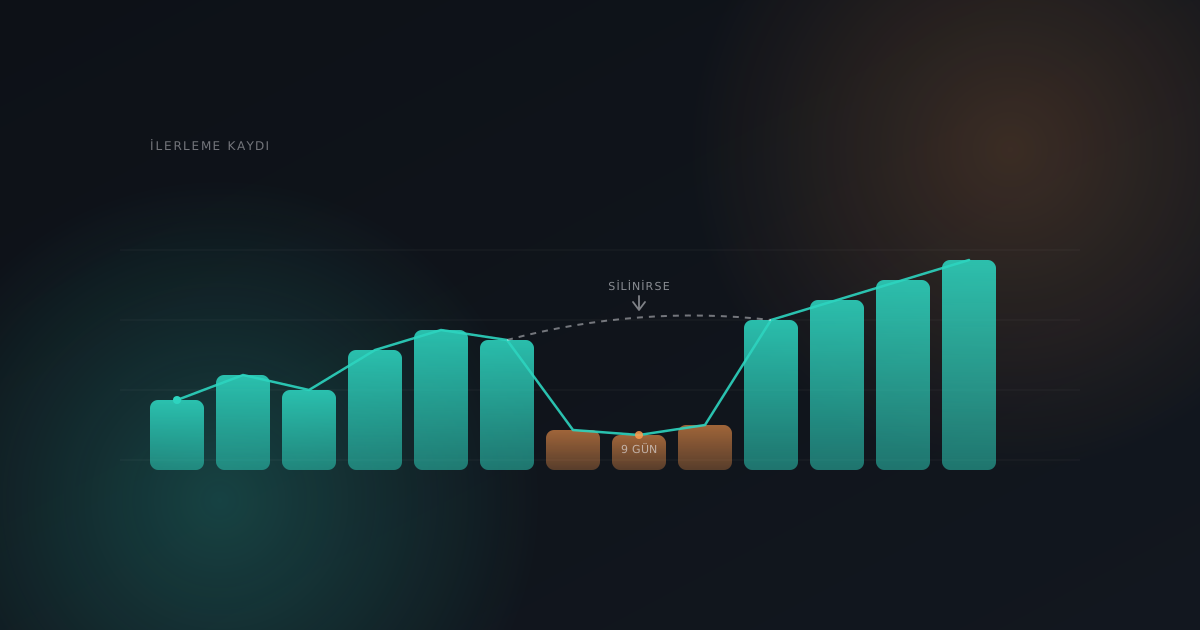
Logging only nine days in February is evidence that February went badly. Deleting that evidence doesn’t make February go well in hindsight — it just produces a curve where February never happened. What’s left looks smoother, but it isn’t accurate anymore, and reading a curve that isn’t accurate to judge your own progress is functionally not that different from not tracking at all.
Take a concrete case: someone who trained zero times in the four weeks after an injury. Deleting those four weeks from the record makes the setback look like it never happened — except the body lived through those four weeks, and conditioning genuinely slipped during them. If the record doesn’t show that dip, the answer to “why don’t I feel as strong as I did two months ago” disappears along with it, because the answer was sitting inside the four weeks that got erased.
What does deleting a bad month actually change, and what doesn’t it?
Deleting a bad stretch doesn’t undo what happened during it — it only removes the visible trace of it. A nine-day February was lived as a nine-day February; taking it out of the record doesn’t change that, it just makes it invisible the next time someone looks back. Short-term, that can feel like relief — the curve looks cleaner. Long-term, it creates two separate records: one in memory (a bad month happened, and you know it) and one on screen (that month doesn’t appear to have happened at all). When those two versions conflict, the one people tend to trust less over time isn’t memory — it’s the screen. That’s how someone ends up not trusting their own tracked data anymore.
Why does an honest progress curve have to include the bad stretches?
Research on self-monitoring and behavior change points to the benefit coming not from showing only the good days, but from maintaining a current, complete feedback loop. Michie and colleagues’ 2009 meta-regression, reviewing 122 diet and physical-activity interventions, found self-monitoring — especially combined with other self-regulation techniques — was consistently among the most effective behavior-change techniques studied. That effect comes from a record kept as-is, not a cleaned-up version of it, because the whole mechanism depends on being able to look at what actually happened and tell what worked from what didn’t.
Li, Dey, and Forlizzi’s 2010 CHI paper on personal informatics systems describes the “reflection” stage of self-tracking as, essentially, looking back at your own accumulated data — and identifies gaps, or “lapses,” in tracking as one of the most common barriers users run into at that stage. The important part is how the paper treats those lapses: not as a flaw that invalidates the record, but as a normal, expected part of it. Deleting a bad month doesn’t resolve that lapse — it just hides it, and a hidden lapse is one that can never actually be reflected on.
This has a plain everyday version too: a good stretch only really means something next to the bad one that came before it. “I could only manage nine logged days three months ago, and now I’m at twenty-five” is a sentence that only holds together because the nine-day month is still sitting in the record. Delete it, and the actual distance covered disappears along with it — there’s nothing left to measure the improvement against.
A deleted bad month vs. one kept in context
| Criterion | Deleted bad month | Kept in context |
|---|---|---|
| How it appears on the curve | Invisible, no gap shown | A low but visible segment |
| Effect on projections | Artificially optimistic slope | Based on the real underlying trend |
| Consistency with your own memory | Conflicts — you remember it happening | Consistent — the screen matches memory |
| Long-term effect on motivation | Trust in the record erodes over time | The record stays credible |
| Response to the next bad stretch | Reinforces deleting it again | Reinforces keeping it in context again |
Cookrange’s principle: instead of deleting, add context
In Cookrange, progress analytics runs on one long column spanning months, and no stretch of it gets removed. A February with only nine logged days stays in the record as a low but visible segment; a 94-day streak held through the summer sits in that same column the same way. A strong December can sit right next to that nine-day February — neither one cancels the other out or makes it invalid; both are simply part of the same record.
The practical consequence is that 30/60/90-day projections get generated from that same complete record. A weak week or month isn’t excluded from the calculation, because excluding it means the trend the projection is built on is no longer the real trend. The logic behind those 90-day projections rests on exactly this principle: the more complete the history behind it, the more the projection is worth trusting.
Frequently asked questions
Does deleting one bad month really matter that much? It’s less about that single month and more about the habit it creates. Once it’s deleted once, the same instinct tends to show up during the next rough patch — and over time, what’s left is a “clean” curve that no longer reflects any real difficulty at all.
Doesn’t seeing a bad month hurt motivation? It can feel uncomfortable in the short term, but what actually hurts motivation is usually the absence of context around it, not the month itself. Seeing a low segment alongside what came before and after it tends to read as a point on the curve, not as a failure.
What if I want to delete my old data entirely? That’s available through account and data settings, and it’s a personal choice. The principle described here is about what the system does by default — it doesn’t quietly prune history or hide low-performing stretches in the name of tidiness.
Where to start
If an app currently shows only the weeks that went well and quietly drops the ones that didn’t, the curve being looked at probably isn’t the real history — it’s an edited version of it. Cookrange doesn’t delete history, it only adds context to it; anyone who wants early access can join the waitlist.