Nutrition
Why Calorie Counting Alone Fails Long-Term
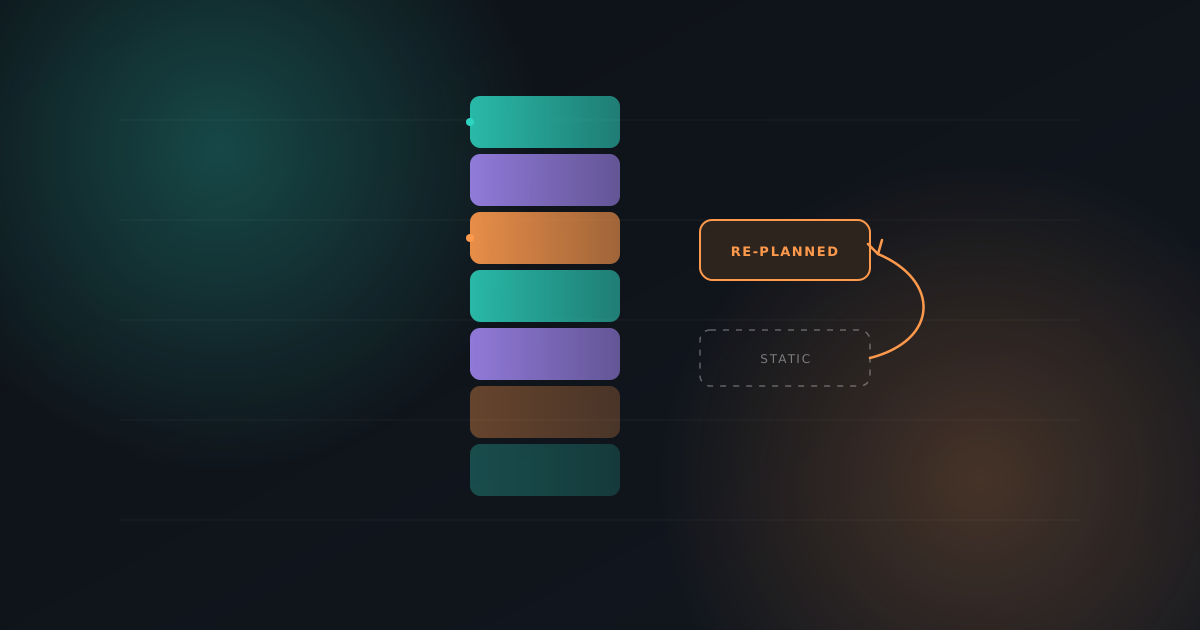
Calorie counting fails long-term because it depends on one number calculated once, and that number never gets revisited even as your actual energy needs shift week to week. A target that was accurate the day you set it up quietly stops being accurate a few weeks later, and nothing in a typical tracker tells you that — it just keeps showing you the same figure.
Why does calorie counting stop working after a few weeks?
Most calorie-tracking setups ask for your age, height, weight, and a rough “activity level” — sedentary, lightly active, active — and from that they produce a single daily target that sits there indefinitely. The problem is that real days aren’t that flat. A day with a long walk and a day on the couch, a heavy training day and a rest day, a five-hour night and an eight-hour night — each of these measurably changes how much energy you actually need. A static target has no way to see any of that; it just keeps rendering the same number regardless of what happened.
In practice, this produces one of two outcomes. Either the gap between the target and reality grows until you stop trusting it and quietly stop logging, or you keep forcing yourself to hit a number that no longer matches what your body is doing, which tends to end in either needless restriction or burnout. Both get described afterward as “calorie counting didn’t work for me” — but the thing that actually failed wasn’t the counting. It was that the target was never updated.
Where does a static plan crack first?
The clearest failure point is that bodies adapt over time. A body kept in an energy deficit responds by lowering its resting metabolic rate somewhat, a mechanism documented plainly in Fothergill and colleagues’ 2016 follow-up on “The Biggest Loser” contestants, which found resting metabolic rate remained well below the level predicted for their body size even six years after the competition ended. That doesn’t mean progress is impossible — it means a calorie target that was correctly calculated a year ago is mathematically wrong today, before you even factor in the day-to-day swings in walking, training, and sleep layered on top.
A printed diet sheet, or a plan generated once inside an app and never touched again, drifts out of accuracy for exactly this reason. The inputs changed. The output didn’t.
What does an “adaptive plan” actually mean?
An adaptive plan keeps the target itself separate from what you actually burn that day, instead of computing one number and locking it in forever. Here’s how Cookrange does it: you log the exercise you did — the activity and the minutes — and the estimated calories burned appear on top of the day’s target as a passive number, so a 2,180 kcal target might show as 2,410 kcal on screen after an afternoon walk. That doesn’t mean the target itself changed; it means the extra energy you burned that day is made visible to you. The breakfast you logged this morning, or the lunch you already logged, is never recalculated.
Updating the target itself is something you ask for explicitly — you regenerate the plan through Cookrange AI, and the new target applies from that point forward, never rewriting history. The distinction worth holding onto: this isn’t “the system deciding for you,” it’s “not hiding the real numbers from you, and putting a new target in front of you within seconds whenever you ask for one.”
Static target vs. adaptive plan
| Criterion | Static calorie target | Adaptive plan (Cookrange) |
|---|---|---|
| When the target is calculated | Once, at setup | Whenever you regenerate the plan |
| Response to unplanned activity | None — target stays the same | Calories burned show up on top of the target instantly |
| Effect on meals already logged | N/A — nothing changes anyway | Unchanged — regeneration only covers what comes after |
| Relationship to metabolic adaptation | Target drifts from reality over time | Realigns with current data the moment you regenerate |
| What the user has to do | Notice the drift and correct it manually | Regenerate the plan whenever a new target is wanted |
Does this mean logging stops mattering?
No — if anything, an adaptive plan raises the value of logging, because when you regenerate your plan, the data the system uses is the real record you’ve kept. A 2011 systematic review by Burke, Wang, and Sevick looking across weight-management interventions found that self-monitoring — tracking diet, exercise, or weight — was consistently associated with better weight-loss outcomes. The point isn’t that logging is optional once a system adapts for you; it’s that what you log should actually shape the target you get the next time you ask for a new one, rather than being multiplied against a number that was frozen the day you signed up.
Does “adaptive” just mean “eat whatever you want”?
No. An adaptive plan doesn’t remove the idea of a target — it changes when and against what it gets updated. An unplanned walk or workout shows up as calories burned on top of your target for that day — that information gives you an honest picture, but it doesn’t automatically change the daily target itself. When you want the target updated, you regenerate the plan; that’s what grounds the new number in what actually happened, not in a single assumption made three weeks ago.
Why does the “activity level” dropdown fall short?
Most calorie calculators ask you to pick one activity level at setup — sedentary, lightly active, active, very active — and that single choice becomes a fixed multiplier applied to every day going forward. The category itself is a chain of assumptions: what counts as “lightly active” for one person can look nothing like their actual week, and the same person might sit at a desk all Monday and walk 10 km on Friday, yet the multiplier treats both days identically. The category isn’t a bad idea in itself — it’s a reasonable shortcut for producing a rough estimate — the problem is that it’s chosen once and never revisited, so it can’t capture the swings that actually happen week to week.
This produces a real asymmetry. Someone who picked “active” ends up with excess budget on rest days; someone who picked “lightly active” spends an unusually busy week feeling like they’re constantly running short. In both cases, the issue isn’t that the wrong box was ticked — it’s that a single static box was ever meant to describe a variable week in the first place. Adaptive re-planning doesn’t eliminate this initial estimate, but it reduces how much it matters, because whatever the starting guess was, the system keeps correcting it against what actually happened that day.
Frequently asked questions
Does the calories-burned display only respond to walking data? Cookrange reads no step or distance data from your phone: there is no Apple Health or Google Fit connection, so the calories-burned figure comes entirely from the exercise you log yourself — you pick the activity and the duration, and the estimate is computed from that. An automatic movement source may be added later; the safe assumption today is that nothing is counted unless you logged it. When you regenerate your plan, the system factors in everything you’ve logged up to that point.
Won’t the number changing during the day be confusing? What changes isn’t the target itself — it’s the “calories burned” figure shown on top of it. Meals you’ve already logged are never recalculated retroactively. In practice, what you see is a target that stays fixed with a “+230 kcal burned” note layered on top; if you want the target itself to change, that happens when you regenerate the plan.
Is a fixed target or an adaptive one safer with respect to over-restriction? That depends on someone’s individual history and health status; anyone with a history of disordered eating or a medical condition affecting diet should talk to a healthcare professional before adopting any tracking approach. In general terms, an adaptive plan doesn’t remove the target — regenerating it updates the data the target is based on, which makes it more current when you choose to update it, not inherently looser or stricter.
Where to go from here
If the app you’re using today only shows you “1,900 calories” and has no explanation for why that number hasn’t moved in a month, the question worth asking is simple: is this target still accurate for me? Cookrange’s AI coach layer and nutrition planning page describe how this gets handled in more depth, and the how it works page walks through the full flow end to end. Cookrange is currently at v0.9.6 internal alpha; anyone who wants early access can join the waitlist.
The short version: calorie counting itself isn’t a bad habit. The problem is a number that never gets asked whether it’s still true. Instead of walking toward the same fixed target for three months regardless of what actually happens, it’s reasonable to expect the target to keep pace with you.