Gym Ecosystem
How Seeing a Friend Is Already at the Gym Gets You Moving
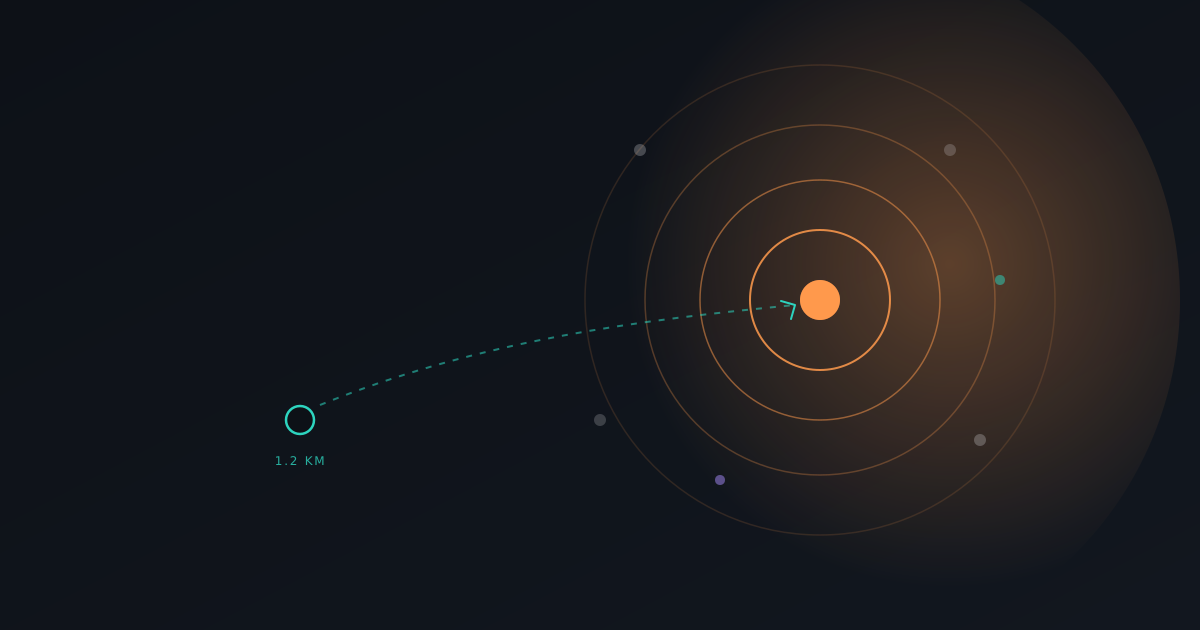
Knowing a specific friend is at the gym right now lowers the activation energy to go there far more than a generic “time to work out” reminder, because the second is an abstract prompt and the first is a concrete, verifiable social fact. “Deniz checked in 40 seconds ago, 1.2 km from you” moves the decision out of the “maybe later” category and into “right now” — because there is now an actual, present person on the other end of it.
Why doesn’t a generic reminder do the job?
A standard push notification — “don’t forget your 30 minutes today” — carries zero social information. It doesn’t say who else is doing it, who isn’t, or who’s currently there; it just restates a task. The research on this kind of generic prompting is not encouraging. A 2018 study by Beatty and Katare, published in the Journal of Health Economics, compared two low-cost interventions inside a university dormitory setting: a lottery-based financial incentive, and a “social norming” treatment that gave people feedback on their own exercise activity alongside their peers’. The lottery incentive produced a statistically significant increase in physical activity. The generic social-norm feedback — essentially an abstract “here’s how your average compares to your peers’ average” — showed no detectable effect at all.
That finding matters because it undercuts the assumption that any social framing automatically works. So does “social proof” simply not apply here? Not exactly — the more likely explanation is that there’s a real difference between an abstract statistic and a specific, known person. That distinction hasn’t been tested directly in a gym check-in context yet, but it’s a reasonable inference from the broader pattern in this research, not a settled fact.
Does the presence of other people actually change behavior?
The oldest reference point here is Norman Triplett’s 1898 observation, widely credited as the first experiment in social psychology: competitive cyclists posted faster times racing against another rider than racing alone against the clock. A modern reanalysis of that experiment notes that the original data wasn’t as statistically strong as it’s often described, but that the broader idea — the bodily presence of others changes performance — has held up well over the century since. Closer to the specific context of exercise, Carron, Hausenblas, and Mack’s 1996 meta-analysis found that the presence of co-exercisers has a small-to-moderate but consistent positive effect on exercise adherence across the studies it reviewed.
Generic prompt vs. specific presence: what’s actually different
| Dimension | Generic/anonymous reminder | Specific, known-person signal |
|---|---|---|
| Information carried | An abstract task or peer-average statistic | A specific, verifiable person and moment |
| Research support | Beatty & Katare (2018): generic social-norm feedback showed no detectable effect | Carron et al. (1996): presence of co-exercisers improves adherence |
| Emotional weight | Low — a number, not a person | Higher — someone you know, right now, right there |
| Decision it triggers | “Maybe later” | “I could go now” |
| Privacy shape | Often aggregate/anonymous data | Limited to mutual friends, opt-in by design |
How does Cookrange apply this distinction?
Rather than sending a generic “today’s your workout day” push, Cookrange’s gym ecosystem shares check-in presence between mutual friends: when a friend checks into the gym, you see how far away you are and how long ago they arrived. This is limited to friends who’ve mutually opted in — location isn’t tracked continuously, only the check-in moment itself becomes a signal. While walking there, the remaining distance and estimated arrival time are tracked on the phone; once you arrive, you can see the gym’s current occupancy and how busy it is (for example, “34 people inside, low density”). The gym ecosystem page covers this flow, and community & squad covers how this signal connects to the broader social layer.
Is this just social pressure by another name?
The intent is to lower the threshold, not apply pressure. The “should I go or not” decision usually gets lost in ambiguity and inertia; knowing “someone I know is there right now” makes the decision concrete — it stops being an abstract “I should go” and becomes “if I go now, I’ll be training alongside someone I actually know.” Beatty and Katare’s finding fits this framing well: abstract, impersonal social comparisons stay weak, while concrete, personal signals plausibly work through a different mechanism entirely.
When does this signal stop working?
This mechanism has its own failure mode: if a “your friend is at the gym” notification fires too often, from people you barely know, or at times that don’t mean anything, it turns into background noise just like any generic reminder. The signal’s strength comes from being rare and real — someone you genuinely know, genuinely there right now, genuinely nearby. Once any of those three conditions is missing — an unfamiliar user, a gym far outside your radius, someone who checked in hours ago — the notification falls back into the same category as any other easily-ignored abstract prompt.
That’s also directly tied to how the privacy has to be designed: sharing this signal only between mutual friends and only at the actual moment of check-in matters both for privacy and for keeping the signal meaningful. A system built on continuous location sharing would be both more invasive and, over time, would turn an occasional, specific moment into an always-on stream that loses exactly the power a rare signal has.
What happens on the walk there?
Even after the decision to go has been made, the stretch of time between leaving the house and arriving is its own drop-off point. On a walk of, say, fourteen minutes, not knowing how much distance is left is its own small source of friction — people tend to be less willing to sustain an effort when they can’t estimate how much longer it will take. That’s why showing a live countdown of remaining distance and estimated arrival time on the way there is as much a part of this mechanism as the original presence signal: the “your friend is there” cue gets you out the door, and a live “12 minutes left” readout reduces the odds of turning back partway. Together, they support both the start of the decision and its follow-through.
A third layer kicks in on arrival: knowing the current occupancy and how busy it is (something like “34 people inside, low density”). That doesn’t affect the decision to go — it affects how comfortable the first few seconds through the door feel. Knowing roughly what to expect, rather than walking into an unfamiliar, potentially crowded space, removes one more source of hesitation, particularly for someone newer to a gym.
Frequently asked questions
Can this notification be turned off? A social signal like this should, by definition, be optional — not everyone wants the same level of notification, and for some people this kind of real-time social information is distracting rather than motivating. Being able to turn this off is a reasonable expectation of any feature built this way.
Can the gym itself see this data? The design is built so a gym can see its own overall occupancy and peak hours, without access to any individual member’s health or body data — the information exchanged between gym and member stays at a collective, anonymized level.
Does this only make it easier to go, or does it help you stay longer once you’re there? The focus is on lowering the threshold to walk in the door in the first place; how long you stay once you’re inside depends far more on personal motivation, your goal for that session, and how you’re feeling that day. The signal’s contribution is specifically to the decision to show up.
The takeaway
A generic reminder isn’t a strong enough signal to change behavior on its own — there’s direct research showing exactly that. But knowing a specific person is at the gym right now, a specific distance away, falls into a different category — one with support both from the oldest findings in social psychology (Triplett, 1898) and from more recent meta-analyses specific to exercise (Carron et al., 1996). The how it works page covers how this mechanic connects to the rest of the app. Cookrange is currently in v0.9.6 internal alpha; anyone who wants to try this feature early can join the waitlist.