Nutrition
How TDEE Is Calculated, and Why It Shouldn't Stay Fixed
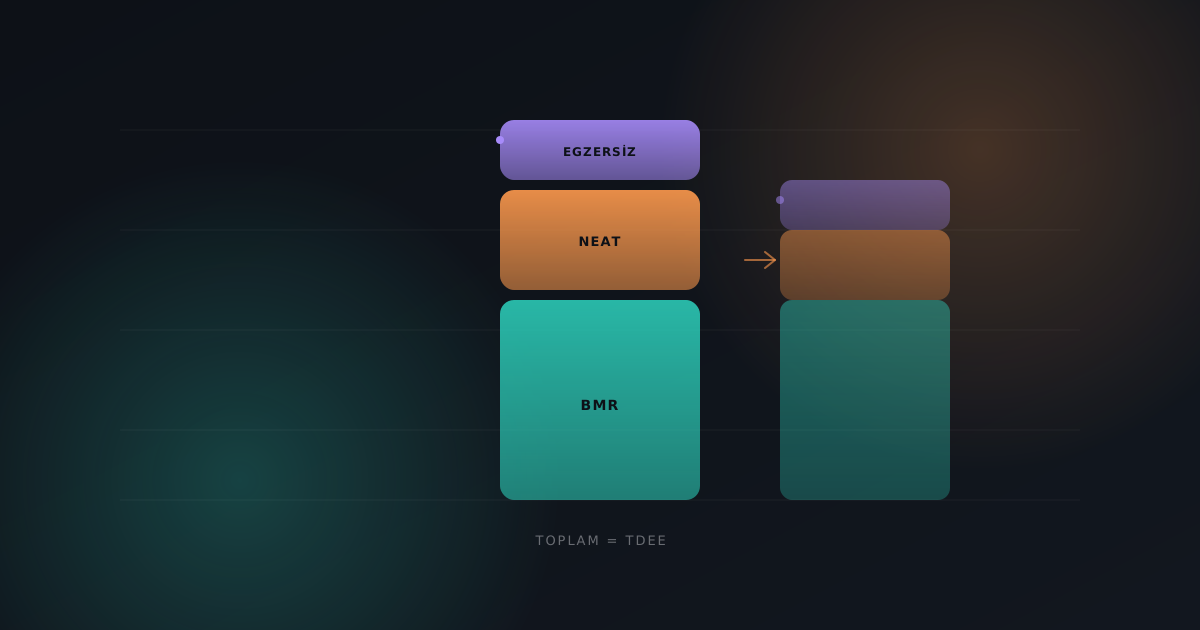
TDEE — total daily energy expenditure — isn’t a number you calculate once and write down; it’s the sum of four components that reshape themselves every day. The “you burn 2,200 kcal a day” number an app gives you at signup is its best estimate for that one day. If you’re still living against the same number three weeks later, you’re probably working from a target that’s already wrong.
What TDEE is actually the sum of
TDEE has four components, and how much each one weighs varies enormously from person to person:
- BMR (basal metabolic rate): the energy your body spends doing nothing but staying alive — heartbeat, breathing, cell turnover. Usually the largest single share of total TDEE.
- NEAT (non-exercise activity thermogenesis): every movement that isn’t formal exercise — walking, standing, chores, fidgeting. The most variable component of the day, and the one most often ignored.
- Exercise-related expenditure: the energy planned training (gym, running, sport) burns.
- Thermic effect of food: the energy spent digesting what you eat — usually a small but fairly constant slice of the total.
Of these four, BMR changes comparatively slowly, but NEAT and exercise expenditure can swing hard day to day — a day spent at a desk versus a day spent hitting 10,000 steps can move TDEE by hundreds of calories.
Why does TDEE change from day to day?
The biggest variable is NEAT, because it’s the hardest to measure and, visibly, the most inconsistent component. The gap between a day spent sitting at an office and a day spent on your feet or walking for 3-4 hours can easily reach 300-500 kcal — equivalent to a full training session, yet logged as no “exercise” at all. Levine’s 2002 review of NEAT found that between-person NEAT variation can reach up to 2,000 kcal a day — meaning this single component alone can invalidate a TDEE estimate almost entirely.
Add in the natural swing of training load (leg day vs. rest day), sleep quality, and even ambient temperature, and it becomes clear that a “fixed” TDEE number should really be a fresh estimate every single day.
How accurate are the standard formulas?
Widely used formulas like Mifflin-St Jeor estimate BMR from height, weight, age and sex with reasonable accuracy — Frankenfield, Roth-Yousey and Compher’s 2005 comparison study found Mifflin-St Jeor more accurate than other common formulas in healthy adults. But these formulas only estimate BMR; getting to TDEE means multiplying that number by an “activity factor” — usually chosen from a crude, four-or-five-option box (“sedentary”, “lightly active”, and so on). So the formula itself is reasonable, but the activity estimate stacked on top of it stays crude — exactly where NEAT is most variable.
Where a fixed TDEE target breaks down
If an app hands you one TDEE number at signup and never updates it, that number is most accurate on the day you signed up and only stays correct afterward by coincidence. When your activity level changes — a new training routine, a job change, a seasonal drop in movement — the fixed number falls behind, and you end up either overeating (if your TDEE dropped but you’re still eating to the old, higher number) or under-eating (if your TDEE rose but you’re still restricting to the old, lower one).
Static TDEE vs. adaptive calculation
| Criterion | Static TDEE (once at signup) | Adaptive calculation (Cookrange) |
|---|---|---|
| BMR | Calculated once from height/weight/age | Same, rarely changes |
| NEAT/activity | Locked to a crude box | Recalculated from real step/distance data when you regenerate the plan |
| Training days | Not accounted for, or added by hand | Reflected from logged training the next time you regenerate |
| Accuracy over time | Drifts from reality as activity changes | Realigns with current data once you regenerate |
| User effort | None (but the number goes stale) | Regenerating is required (but the number stays current) |
What keeping TDEE current actually looks like
The adaptive approach keeps the BMR estimate fixed (that component genuinely changes slowly) while treating exercise expenditure as the part that moves. In Cookrange that comes from the exercise you log yourself rather than from the phone — there is no step or activity source, so NEAT is the part it cannot see. It shows up in two ways: first, the estimated calories burned from an activity you log — say, an afternoon walk — are shown by the Cookrange AI layer on top of the day’s target as a passive number (a 2,180 kcal target might display as 2,410 kcal), without the target itself changing or touching meals already logged. Second, when you regenerate your plan, the TDEE estimate is recalculated from scratch using the real step/distance/training data you’ve accumulated up to that point, and the new calorie target applies from then on. See how it works for the full mechanism.
Frequently asked questions
Isn’t calculating my TDEE correctly once enough? If your activity level stays genuinely constant (same job, same training routine, same season), it might hold up for a while. But that’s rare in practice — even most people’s weekly activity fluctuates, which is enough to make a one-time calculation stale quickly.
How would I track NEAT myself? Manually isolating NEAT is hard, because “movement that isn’t exercise” is exactly the kind of thing most people never consciously log. A system reading the phone’s step/distance data captures that without you having to do anything extra; when you regenerate your plan, that data feeds directly into the TDEE calculation.
What if the TDEE estimate is wrong? A single inaccurate estimate isn’t a big deal on its own; the real risk is a wrong estimate being used, uncorrected, for weeks. Regenerating your plan at regular intervals reduces that risk, because each regeneration realigns the estimate with current data instead of letting the error compound.
Where to start
If your TDEE was calculated once, months ago, and hasn’t been touched since, you’re probably living against a number that no longer reflects how you actually move. In Cookrange you can regenerate that calculation with current data any time you want — join the waitlist for early access.