Nutrition
How to Track Macros, and Who Actually Needs To
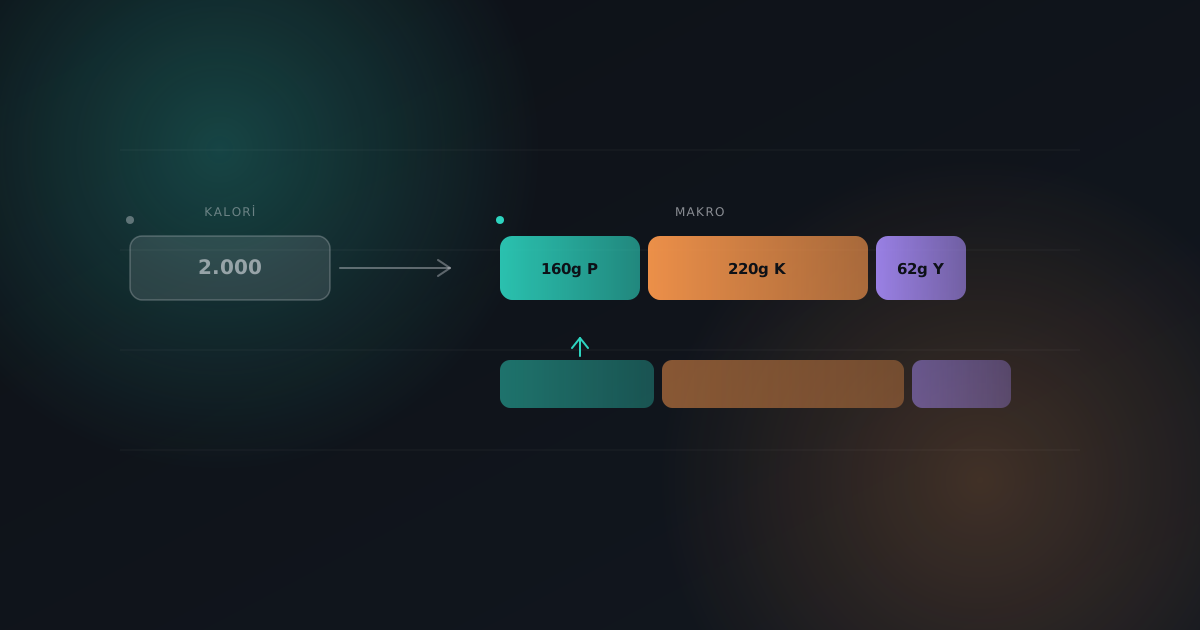
A calorie count tells you only “how much” you ate; a macro breakdown tells you “what.” Two people can eat the same 2,000 calories — one mostly from protein and vegetables, the other mostly from sugar — and the mark that leaves on the body, especially on muscle mass and satiety, isn’t the same. Macro tracking is what makes that difference visible.
How to track macros: five steps
- Set a daily calorie target first. Macros are a split of a calorie budget, so the budget has to exist before the split does. Maintenance calories is the reference point you work from, and a goal moves you above or below it. The calorie calculator runs this step with the Mifflin-St Jeor equation and returns a target plus a starting macro split.
- Set protein by bodyweight, not by percentage. A percentage-based protein target silently shrinks every time the calorie target drops, which is the opposite of what a deficit calls for. Grams per kilogram of bodyweight holds steady; the remaining calories are then divided between carbohydrate and fat.
- Log every meal, including the ones that don’t feel like meals. The gap between a tracked day and an accurate day is almost always a handful of untracked items — a sauce, a coffee, a few bites while cooking. Barcode, photo and quick-add logging exist so the low-effort items don’t get skipped.
- Read the week, not the day. A single day landing off target says very little. The weekly average is the number that corresponds to what actually happens to bodyweight and lean mass.
- Recalculate when the calorie target moves. This is the step that gets skipped by hand. A new calorie target with the old macro split is not the same plan — see below for why the two calculations have to move together.
What are macros, and how is this different from counting calories?
“Macros” is short for macronutrients: protein, carbohydrate and fat. Each carries a different amount of energy per gram (protein and carbs roughly 4 kcal per gram, fat roughly 9), but more important than the energy is the job each one does in the body. Protein handles muscle repair and satiety, carbohydrate handles energy and training performance, and fat handles hormone production and vitamin absorption. Looking only at calories compresses three different jobs into one number and treats them as interchangeable.
In practice, that means someone who hits their calorie target while largely neglecting protein can lose weight and still lose a meaningful share of it as muscle mass — usually not the intended outcome. Helms, Aragon and Fitschen’s 2014 review found that higher protein intake consistently helps preserve lean mass in athletes eating at a calorie deficit.
Who actually needs to track macros?
Not everyone needs to count grams of protein. Macro tracking earns its keep in three concrete situations:
- Anyone trying to preserve or build muscle. Under-eating protein in a calorie deficit means some of what you lose comes from muscle. For this group, the protein target can matter more than the total calorie number.
- Performance athletes. Carbohydrate timing relative to training load directly affects recovery and performance; looking only at calories misses that detail entirely.
- Anyone with a specific body-composition goal. “Losing weight” and “losing fat while keeping muscle” are different goals, and the second one is hard to pursue without macro awareness.
For someone whose primary goal is general health or moderate weight management, calorie tracking alone is often a sufficient starting point — macro tracking there is an optional level of detail, not a requirement.
How are macro targets calculated?
The standard approach works like this: a daily calorie target is set first, then that calorie budget is split into protein, carbohydrate and fat, either as a percentage or as grams per unit of body weight (e.g. roughly 1.6–2.2 g of protein per kilogram, with the remaining calories split between carbs and fat). The math itself isn’t complicated, but it becomes a hassle for two reasons: (1) tracking grams manually at every meal is tedious, and (2) whenever the daily calorie target changes (see the next section), the macro targets need to be recalculated proportionally too — a step that gets skipped almost every time it’s done by hand.
Should macros change when the calorie target changes?
Yes, and this is the part most commonly missed. Your daily calorie target updates when you regenerate your plan; when that happens, the macro split needs to move with it — otherwise your calorie target changes while your protein target quietly falls behind. In Cookrange these two calculations are never separated: when you regenerate your plan and the daily target moves, say from 2,180 to 2,410 kcal, the protein target scales up proportionally at the same moment — one is never updated while the other is forgotten.
Manual math vs. automatic tracking
| Criterion | Manual macro math | Automatic tracking |
|---|---|---|
| Calculation | Redone by hand on every change | Calculated automatically together with the calorie target when you regenerate the plan |
| What a logged meal shows | Usually calories only | Protein/carb/fat grams instantly |
| Barcode/photo logging | Macro data has to be looked up separately | Comes along with the log automatically |
| Margin for error | High — percentages computed by hand | Low — the system computes it |
| Daily effort | An extra step | Requires no extra step |
What macro tracking looks like in Cookrange
Every logged meal arrives with protein/carbohydrate/fat grams, not just a calorie number — whether it’s logged by barcode, photo, or quick add. The home screen shows progress against daily protein, carbohydrate and fat targets separately, and the estimated calories burned from the exercise you log show up on top of the day’s target alongside them. See nutrition and planning for the detail, and Cookrange AI for exactly what does and doesn’t change automatically.
Frequently asked questions
Does macro tracking replace calorie tracking, or add to it? It adds to it. Calories show total energy, macros show how that energy is split; neither replaces the other, and together they give a more complete picture.
What happens if I don’t hit an exact macro ratio? A single meal or day landing a bit off target rarely matters; what matters is the weekly average trend. Chasing a rigid, inflexible percentage at every single meal is more effort than most people actually need.
Should everyone’s protein target be the same? No — it depends on body weight, activity level and goal (preserving muscle, building muscle, general health). Cookrange calculates these targets from a user’s profile; anyone with a specific medical condition or an athletic program should still check with a dietitian.
Where to start
If all you currently see is a single calorie number with no visibility into whether your protein is even close to adequate, the real question this piece raises probably applies to you too: “how much of what I’m eating is actually doing the job I need it to?” Cookrange tracks that distinction automatically — join the waitlist for early access.