Food Logging
How Barcode Scanning Technology Actually Works
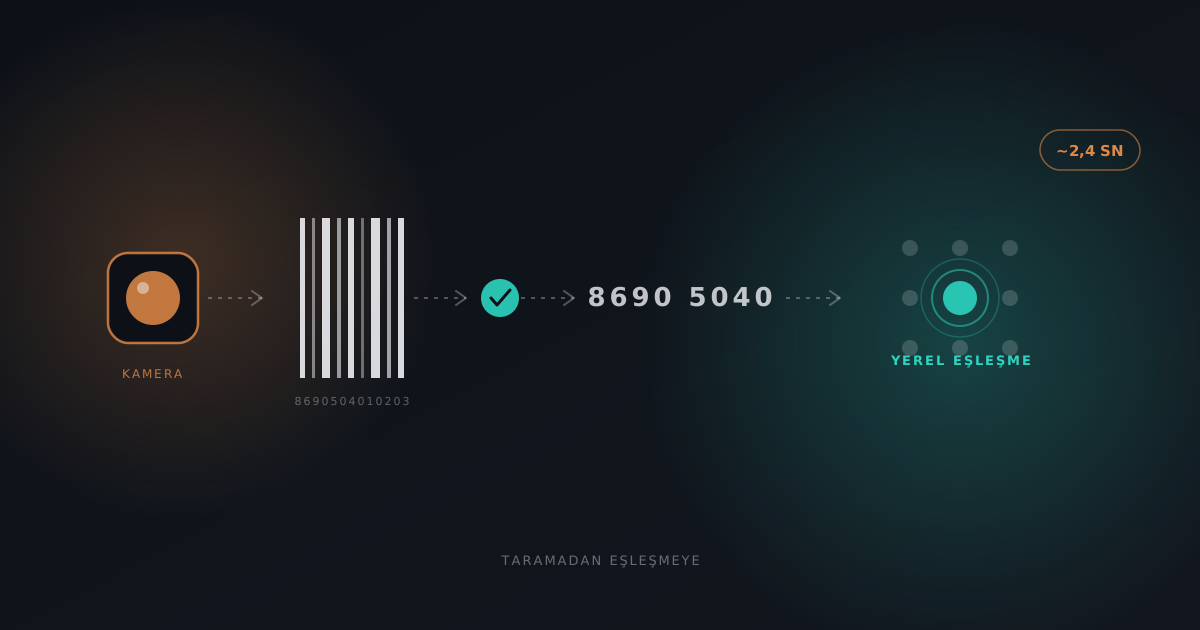
Decoding a barcode is a fast, standardized, close-to-error-proof step — a global standard defines exactly how it works, and every phone camera follows the same rules. That’s not the hard part. The hard part is figuring out which product, and which nutrition values, that decoded number actually corresponds to. In Cookrange, that lookup runs against Open Food Facts, a global, crowd-sourced product database — and most of what determines whether a scan succeeds isn’t reading the barcode, it’s whether that specific product has already been catalogued there.
What does a barcode actually encode?
Most barcodes on retail packaging follow a structure defined by the GS1 standard: EAN-13 or UPC-A. That number isn’t random — the first few digits are a country/company prefix showing which national GS1 member organization issued it (in Turkey, that’s GS1 Turkey, operating under the country’s Union of Chambers, TOBB), the middle digits identify the manufacturer and product, and the final digit is a check digit. That check digit is calculated from every preceding digit using a Modulo 10 algorithm, and it’s what catches a misread digit the instant a scan happens.
How does a camera actually “read” a barcode?
A phone camera isn’t a light source here — it’s a sensor reading how ambient light reflects off the barcode: black bars absorb light, white spaces reflect it back. The image-processing layer converts that reflected pattern into bar widths, and those widths into a digit sequence. As long as the barcode itself is in focus, this step takes a small fraction of a second — and the check digit gets validated right there, so a blurry or partial frame gets rejected before it ever reaches a database.
The actual bottleneck in this chain is rarely the code — it’s the physical conditions around the scan. Autofocus needs a fraction of a second to lock onto the right distance and sharpness, and low light, a reflective package surface, or a phone held too close or too far can all stretch that step out. So the answer to “why does this sometimes scan instantly and sometimes take a few tries” usually has less to do with software and more to do with the physical conditions between the camera and the barcode.
What happens after the number is decoded: database matching
The barcode itself is only an identifier — it says “this number is registered to this manufacturer,” but it carries no nutrition data. Finding what that number actually corresponds to is a separate step: the decoded number gets sent as a query to a database and matched against that database’s product-plus-nutrition record. Decoding is bound to a universal standard; whether a match is actually found depends entirely on which database gets asked.
Why does database coverage decide accuracy?
This is where the real difference for Turkey shows up. A crowd-sourced food database grows one contribution at a time, and it naturally accumulates faster around whichever markets have the most active contributors — historically Western Europe and North America for Open Food Facts. A product that nobody has gotten around to logging yet may simply not be in there, even though its barcode is perfectly valid and decodes correctly. A regional dairy brand or a locally-sold snack in Turkey can carry a completely proper barcode issued through GS1 Turkey, and still have no match in the database if nobody has scanned and submitted it yet. So accuracy isn’t decided by scan speed — it’s decided by how well that shared, growing database happens to cover your specific market today.
So what actually determines whether a scan succeeds?
The variable step in the full pipeline isn’t decoding the barcode — that part is close to instantaneous. What varies is whether Open Food Facts already has a matching record for that exact product: the name, portion size, and protein/carb/fat values. For a globally distributed brand, that record almost certainly already exists, contributed by someone else who scanned it first. For a regional Turkish brand, it depends entirely on whether a previous user — anywhere in the world, but realistically most likely another user in Turkey — already scanned and submitted that product. That’s the real variable, and it has nothing to do with how fast a camera reads bars and spaces.
The barcode itself vs. the database match
| Dimension | The barcode itself | The database match |
|---|---|---|
| What it represents | An identifier (a GTIN) | The product and nutrition data behind that identifier |
| Who defines it | A global standard (GS1) | Whichever database the app queries |
| What stays constant | Same structure in every country | Coverage varies country to country |
| Where errors happen | Rarely — the check digit catches most | Often — if the product was never catalogued |
| What improves Turkey-specific coverage | Nothing — already universal | More Turkish products contributed by users |
What happens in the pipeline if a match turns out to be wrong?
The check digit only confirms that the barcode itself was read correctly — it says nothing about whether the database record behind that number is the right product with the right nutrition values. Those are two different failure modes: one happens at the scanning layer (the barcode is misread, and the check digit catches it immediately), the other happens at the matching layer (the barcode is read correctly, but the database record itself is wrong or incomplete). The fix for the second kind isn’t rescanning — it’s correcting the record. When a user flags a wrong match, that correction feeds back into the database, so the next person who scans the same barcode gets the right result.
Frequently asked questions
What happens if the barcode itself is damaged or hard to read? That’s exactly what the check digit is for: if the scanned digit sequence doesn’t match its own check digit, the system won’t treat it as a valid match and asks for a rescan instead of guessing at the wrong product.
Can the same barcode number point to a different product in different countries? The number itself is tied to a single registered record, but which database actually holds that record varies. Genuine collisions do happen in rare edge cases — mostly with internal or restricted-use barcodes — but the far more common issue isn’t a collision, it’s a local product never having entered a large global database at all.
Can something without a barcode, like a bakery item or a home-cooked dish, be scanned? No — barcode matching only works for products that actually carry one. Logging something without a barcode relies on a completely different mechanism: a recipe or portion estimate, which is a separate part of the nutrition planning flow.
The scanning technology itself is a largely solved, standardized problem. What actually matters is what the decoded number gets matched against — which is exactly why Cookrange uses Open Food Facts instead of a closed, proprietary catalog: it’s global, crowd-sourced, and its coverage of Turkish products keeps growing as more people scan and contribute them, rather than depending on one company to build a walled-off local dataset from scratch. Cookrange is currently at v0.9.6 internal alpha — join the waitlist for early access.