Food Logging
Barcode Food Logging: Database Quality Matters More Than Scan Speed
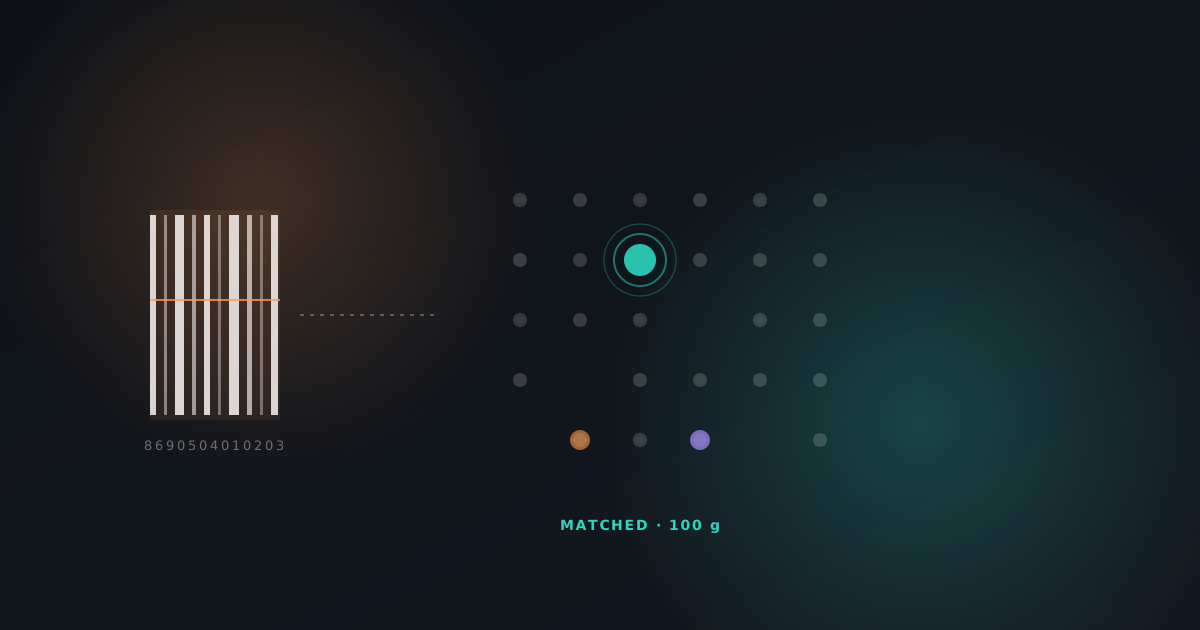
A barcode scanner that opens in under a second is worthless if it can’t find the actual product you just scanned. What determines whether barcode logging turns into a lasting habit isn’t how fast the camera resolves — it’s whether the underlying database recognizes the specific products sold in your specific market.
Why does database quality matter more than scan speed?
Barcode features get marketed around one number: “scans in X seconds.” That number is only half the experience. The other half is what the scan actually returns. Scanning a product in one second and landing on a “not found” screen is a worse experience than scanning the same product in three seconds and getting the right result — because the first case forces you into manual search, a guessed portion size, or skipping the log entirely. What kills a logging habit is usually not slowness; it’s the frequency of those “not found” moments.
This shows up as two separate coverage problems. The first is packaged goods — the yogurt, the snack, the drink on the shelf — most of which technically carry a barcode, but a global database built primarily around one country’s retail catalog won’t necessarily cover a regional or local brand as well as it covers an international one. The second problem has no barcode at all: loose or made-to-order food — a bakery item, a plate from a local restaurant, a home-cooked dish. There’s nothing to scan there; the quality test is how reasonable the recipe and portion estimate is, not barcode matching.
What actually stress-tests a food database?
The test that matters isn’t whether an app recognizes Coca-Cola or a major global snack brand — nearly every database gets those right, because they were built around exactly that catalog. The real test is a regional dairy brand, a local grocery chain’s own private-label product, or a snack that’s only sold in one country. Those products may never have entered a database that was built primarily around a different market’s retail data.
This is exactly why a country’s own official nutrition reference is useful context, not just for a health authority but for evaluating an app. Turkey’s Ministry of Health, for instance, publishes the Türkiye Beslenme Rehberi (TÜBER) 2022, an official dietary guideline that defines local food groups and eating patterns. In the US, the equivalent anchor is USDA FoodData Central, a public, government-maintained nutrient database. A good tracking app’s local entries should line up with — or be traceable back to — a reference like this, rather than defaulting to portion and composition assumptions borrowed from wherever the app’s database happened to be built first.
Does a bigger, more popular database mean a more accurate one?
Not necessarily — and there’s direct research on this. A 2018 study by Griffiths, Harnack, and Pereira, published in Public Health Nutrition, compared the nutrient calculations of five popular nutrition-tracking apps against a reference method (24-hour dietary recalls processed through a research-grade nutrient database). Correlations between the apps and the reference ranged from 0.73 to 0.96 for energy and macronutrients — a real, measurable spread of accuracy even among widely used apps. Being popular is not the same as being correct for the specific item you just logged.
Part of the reason is how these databases actually get built. Large, broad-catalog apps like MyFitnessPal state plainly in their own support documentation that much of their database grows through member-submitted entries that are not systematically verified before publication, alongside a separate, smaller set of “verified” entries. That’s not a criticism of the design — it’s simply how a crowd-sourced catalog scales — but it does mean the same product can end up with multiple conflicting entries, particularly for anything sold in a smaller or more local market that a central review team never gets around to checking.
Scan speed vs. database coverage: what each one actually measures
| Dimension | Scan speed alone | Database coverage and quality |
|---|---|---|
| What it measures | Time between opening the camera and getting a result | Whether the result is the right product with the right values |
| Performance on major global brands | Usually fine | Usually fine |
| Performance on regional/local brands | No effect either way | The real differentiator |
| Behavior on loose food / home cooking | Nothing to scan — irrelevant | Depends on recipe/portion estimation quality |
| Effect on habit formation | Marginal — a two-second gap is barely felt | Direct — repeated “not found” screens are what stop logging |
How Cookrange approaches this
Cookrange’s barcode flow is built to return a result within a few seconds of pointing the camera at a package — but the design’s real focus is matching that scan against Open Food Facts, a global, crowd-sourced product database, and surfacing the correct macro breakdown (protein, carbohydrate, fat) at the right portion size, so a match can be adjusted and added to the meal in one step. Because that database grows from user contributions rather than a closed catalog, coverage of any specific regional or local product depends on whether someone has already logged it — which is exactly the “not found” gap the rest of this post is about. The nutrition planning page covers how this connects to the weekly plan, and how it works walks through the full flow.
What to actually check when evaluating a tracker
The right question when comparing calorie apps isn’t “how fast does it scan” — it’s: does it correctly recognize a local product you buy regularly? Does it offer a reasonable estimate for loose food and home cooking instead of dumping you into a fully manual entry? If a match is wrong, is it easy to correct, and does that correction improve the database going forward? The answers to those questions matter far more than a one- or two-second difference in scan time.
Why does the same product sometimes show two different calorie values?
A common complaint about food-logging apps: scan the same barcode twice, or have two people scan the same package, and you can end up with two different nutrition results. This usually isn’t malice — it’s a structural feature of how these databases get built. A product’s formula or package size can change over time without the barcode changing, regional packaging variants can end up merged under one barcode, or a single entry might simply have been entered incorrectly once and nobody’s flagged it since. No database eliminates this entirely — but whether it’s easy to report an error, and whether that correction actually propagates, is what separates a frustrating day from a workable one.
This is a criterion that’s easy to overlook when comparing apps: “can I correct an entry, and does my correction actually stick?” often matters more in practice than “how many million products does it have.”
Frequently asked questions
How should I log something with no barcode at all, like a bakery item or a home-cooked dish? The relevant question there is whether the app offers a recipe or portion estimate — a reasonable default size and nutrient value for something like a bowl of soup — rather than barcode matching. That’s a separate mechanism from barcode scanning, and it’s just as important a dimension of database quality.
What happens if a small local brand isn’t in the database at all? A well-built app should offer a search experience that suggests the closest comparable item instead of dropping you straight into fully manual entry. Over time, the real difference shows up in how often that “not found” moment happens and how easy it is to work around.
Does a barcode database improve on its own over time? Growth depends on usage volume and how correction feedback gets handled — it’s an ongoing process, not a one-time “finished” state. That’s why it’s worth evaluating not just an app’s current coverage, but how it responds when an error gets reported.
The takeaway
Barcode scanning exists to make logging easier — but what it actually shapes is the entire logging habit, not just the moment of the scan. Speed creates the first impression; how well the database recognizes what you actually eat, especially local and unpackaged food, decides whether that habit survives past week three. Cookrange is currently at v0.9.6 internal alpha; join the waitlist for early access, or check the FAQ for common questions.