Nutrition
Allergen Filtering: Safety in Meal Plans
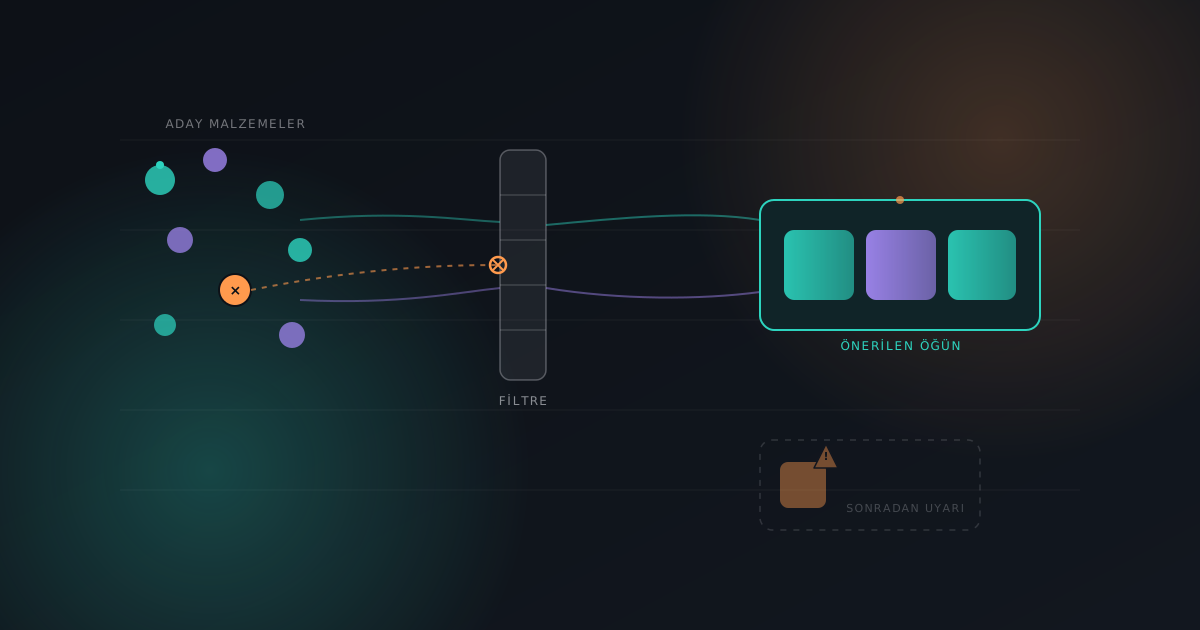
An allergen that never enters a suggested meal isn’t operating at the same safety level as one that shows up and then gets flagged. For someone with a peanut allergy, a warning that reads “this recipe contains peanuts” arrives only after the recipe is already on the screen — reading it, understanding it, and rejecting the recipe is left entirely to the user. Keeping the allergen out of the candidate pool in the first place removes that decision from the user altogether: there’s nothing to notice, because nothing that needed a warning was ever generated.
Why does flagging after the fact fall short as a safety model?
Flag-after-generation works like this: a system builds a suggestion from the full universe of possible recipes and products, then checks that suggestion against a user’s profile and appends a warning icon or line of text. The weak point isn’t technical, it’s behavioral: for a warning to work, someone has to see it, read it, and interpret it correctly. A tired evening, a quickly scrolled list, a small icon that doesn’t register — any one of those can break the chain. Even a perfectly accurate warning only reduces risk to the extent it gets noticed, which makes it a probability, not a guarantee.
Filtering before generation changes the candidate list itself. Once a peanut allergy is entered into a profile, no recipe or product containing peanuts enters the suggestion pool in the first place — there’s no warning to encounter, because there’s no flagged suggestion to encounter it in. The difference sounds small in description, but the outcome isn’t the same: one approach tries to reduce a risk after creating it; the other never creates it.
Where does this filter actually have to run?
A filter is only as good as how many suggestion surfaces it covers consistently. The weekly meal plan, quick-add suggestions, recipe generation, and snack suggestions all draw from the same candidate pool, so the filter has to apply to all of them at once. Filtering the weekly plan while leaving recipe generation unfiltered doesn’t close the gap — it just relocates it.
In Cookrange, this sits inside the nutrition planning layer: peanuts, shellfish, or any allergen entered into a profile get excluded before a user ever sees a meal suggestion. A disliked ingredient runs through the same mechanism — the plan doesn’t tell someone “don’t eat this,” because it was never suggested to begin with. Allergies and preferences technically pass through the same filtering layer; what differs isn’t the mechanism, it’s whether the user marked something as a hard exclusion or a soft preference.
After-the-fact flagging vs. filtering before generation
| Criterion | Flagged after generation | Filtered before generation |
|---|---|---|
| When it kicks in | After a suggestion already exists | Before the candidate pool is built |
| Risk from user error | Allergen stays if the warning is missed | Never entered the candidate list |
| Coverage | Usually one screen | Plan, quick add, recipe generation, snacks — all of it |
| Adding a new allergen | Doesn’t touch past suggestions | Affects the whole pool from the next suggestion on |
| A medical safety guarantee | No | No — neither replaces a medical device |
Where does this tool’s responsibility actually end?
This needs to be said plainly: allergen filtering here is a preference and risk-reduction layer, not a medical allergy-management device. The filter runs on what a user enters into their own profile and on product or recipe data logged in a food database — it cannot detect cross-contamination, a manufacturing change, mislabeling, or a product update that hasn’t been entered into the database yet. Sicherer and Sampson’s 2018 review documents that food-allergy reactions range from mild to life-threatening and that management still relies heavily on careful allergen avoidance — which is exactly why a filter that’s “probably right” isn’t sufficient on its own for someone with a serious allergy.
That scale isn’t a minor detail. Gupta and colleagues’ 2019 study in JAMA Network Open found that at least 10.8% of US adults carry a genuine food allergy, while roughly 19% believe they have one despite reporting symptoms inconsistent with a clinical allergy. That gap matters on its own: even a person’s self-reported allergy status isn’t always precise, which is exactly why a filtering app should treat that input as a preference layer to act on as entered, not claim to verify it medically.
The same limit applies to a packaged product logged by barcode: the filter checks whatever ingredient data is currently entered in the database for that product. If a manufacturer changes a formula, or the same barcode is sold with different contents in a different market, that change isn’t reflected until the database is updated — no filter replaces reading the current ingredient list printed on the package itself.
For someone with a serious or life-threatening allergy, the practical takeaway is this: the filter is a convenience layer worth using, but it doesn’t replace reading labels, asking questions at a restaurant, or carrying whatever an allergist has prescribed for an emergency, such as an epinephrine auto-injector. The terms of service spell out that boundary explicitly.
Frequently asked questions
If I mark an allergen, does that guarantee I’ll never see it again? No — it reduces risk, it doesn’t guarantee it away. The filter depends on the ingredient data logged in the database; a manufacturer change that hasn’t been updated yet, or missing detail in a manually entered recipe, can still slip past it.
Can I use this for a disliked ingredient, not just an allergy? Yes — a disliked ingredient or a general preference, like avoiding a specific type of meat, runs through the same filtering mechanism. What differs is only whether it’s marked as a hard exclusion or a soft preference.
What should I do if I have a serious allergy? Use the filter as a convenience layer, but keep reading labels yourself, keep asking questions at restaurants, and keep following whatever your allergist has instructed, including carrying emergency medication. This tool wasn’t built to stand in for a doctor or a medical device.
Where to start
The real job of an allergen filter isn’t timing a warning correctly — it’s making the warning unnecessary, because the allergen never entered the suggestion pool to begin with. Cookrange applies this filter across the weekly plan, quick add, and recipe suggestions at the same time; anyone who wants early access can join the waitlist.