Nutrition
Why Weight Plateaus Happen, and How Adaptive Planning Helps
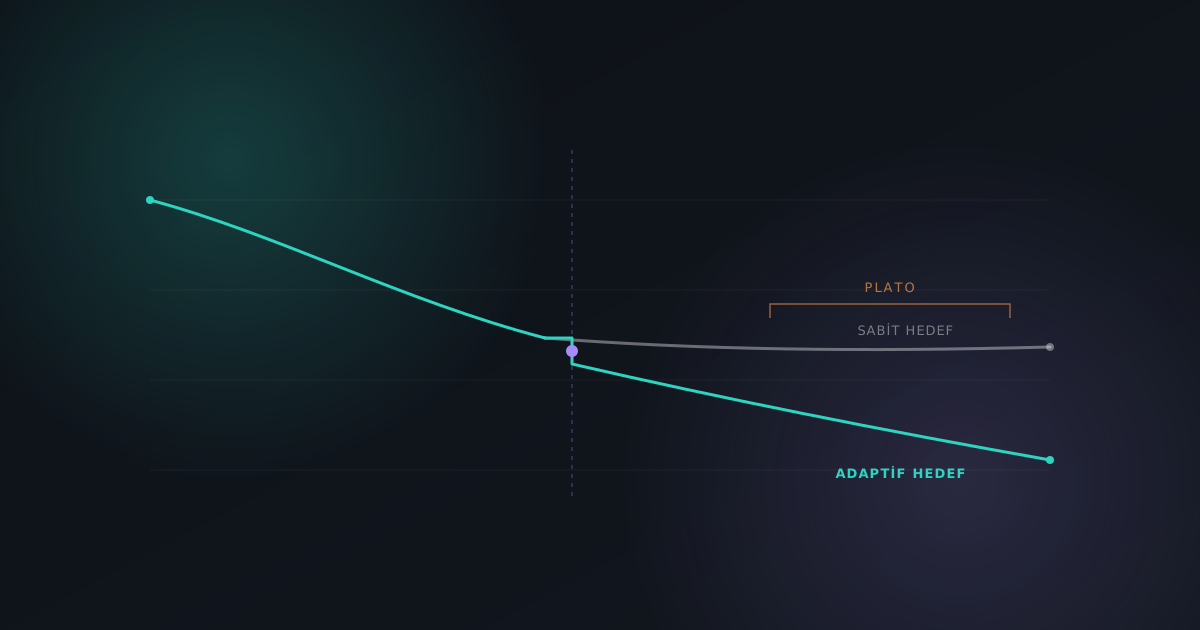
Weight loss doesn’t move in a straight line. Losing weight for weeks on a given calorie target and then losing nothing on that same target for three weeks straight isn’t broken willpower or a diet gone wrong — it’s a well-documented metabolic response: the body answers a sustained energy deficit by lowering the energy it burns.
What exactly is a weight plateau?
A plateau is the stretch where the same calorie deficit that used to produce weight loss stops producing any — inputs (what you eat, how much you move) stay constant while the output (the number on the scale) doesn’t move. It shouldn’t be confused with short-term water retention or normal day-to-day fluctuation; a real plateau is a sustained flatline that holds for weeks.
Most day-to-day scale movement comes from water retention — sodium intake, hormonal cycles, and glycogen stores can shift a scale reading by a few hundred grams in either direction. That’s normal, and it isn’t a plateau. A real plateau is something you can only see in the weekly trend once that daily noise is averaged out and the line is still flat.
Why the body “fights back”: metabolic adaptation
Trexler, Smith-Ryan and Norton’s 2014 review, published in the Journal of the International Society of Sports Nutrition, shows that the drop in total energy expenditure during sustained calorie restriction often exceeds what can be explained by lost body mass alone — a phenomenon called adaptive thermogenesis, or metabolic adaptation. In practice, someone who has lost 10 kilograms can end up burning even less energy than a body that was “always” that weight would — the body cuts costs through hormonal and neuroendocrine pathways, not just through carrying less mass.
One of the more striking illustrations of how large this effect can get comes from an extreme case: Fothergill and colleagues’ 2016 study, published in Obesity, re-measured “The Biggest Loser” contestants six years after the competition and found their resting metabolic rate was still, on average, 499 calories below what would be predicted — even though most of the weight had been regained. That number comes from a group that lost weight unusually fast, so it shouldn’t be read as a typical outcome for anyone cutting calories at a normal pace; but it’s a useful illustration of how large and how durable metabolic adaptation can become. Rosenbaum and Leibel’s 2010 review reaches a similar conclusion from a different angle: keeping weight off is consistently harder than losing it in the first place, and hormonal and metabolic mechanisms are a documented part of why. Part of this overlaps with a quieter drop in daily movement — step count and everyday fidgeting tend to decline without anyone noticing while dieting, and that shift can tangle together with genuine metabolic adaptation.
Sometimes a “plateau” is really incomplete logging
Metabolic adaptation is real and well documented, but not every stall on the scale should be pinned on it. Portions that creep up gradually, a snack that doesn’t get logged, or a weekend meal that goes unrecorded can quietly push actual intake higher — and that produces the exact same result on the scale (nothing moving) for an entirely different reason. That’s why the first thing worth checking when a plateau shows up is whether logging has actually been complete; “did I log everything?” is a simpler question than blaming TDEE or metabolic adaptation, and it’s right more often than not.
Why a fixed plan turns a plateau into a mystery
A calorie target that’s calculated once at setup and left alone makes this adaptation invisible. You keep eating to the same number, but the real requirement on the day that number was calculated no longer applies — energy expenditure has dropped, so the “fixed” deficit has quietly narrowed, sometimes down to nothing. When the scale stops moving, the question that comes up is usually “what am I doing wrong?” — when the more accurate question is “is my target still correct?” An adaptive meal plan moves the whole approach here: instead of a number that stays fixed, the target can be recalculated against real data whenever you ask for it.
How does updating TDEE make a plateau visible?
TDEE isn’t a fixed number — daily expenditure moves with activity level. When a plateau shows up, the real question is whether it’s genuine metabolic adaptation, or simply that daily movement quietly dropped (fewer steps, less time on your feet, fewer workouts) and pulled TDEE down with it. A fixed target can’t tell these two apart, because it’s never questioned again once it’s set. When you regenerate your plan, though, Cookrange AI recalculates TDEE from scratch using your real data up to that point (logs, step/distance history) — if your weekly average step count quietly dropped from 9,000 to 6,000, that shift shows up in the new calculation, and the new target reveals the difference against the old one. A fixed target never reflects that change; regenerating the plan is what brings it into the light. The mechanism behind this is covered on the how it works page. To be direct about it: this doesn’t cancel out metabolic adaptation itself — it just keeps the target accurate enough, when you choose to update it, that a plateau gets diagnosed correctly instead of hidden behind a stale number.
Fixed target vs. adaptive target
| Criterion | Fixed calorie target | Adaptive target (Cookrange) |
|---|---|---|
| When activity drops | Target stays the same, the deficit quietly narrows | Target stays the same too — until you regenerate the plan with current data |
| When a plateau appears | Cause is unclear — feels like “I’m doing the same thing” | Regenerating the plan can separate a TDEE shift from genuine adaptation |
| Recalculation | Has to be done by hand, from scratch | One tap, whenever you want it |
| The metabolic adaptation itself | Unchanged | Unchanged — but at least visible |
Frequently asked questions
Does adaptive planning eliminate metabolic adaptation entirely? No. The body’s tendency to conserve energy is a physiological reality that no software changes. What adaptive planning does is let you keep the target current when you regenerate it, so a plateau can be correctly separated into “a stale number” versus “genuine metabolic adaptation.”
How long do plateaus last, and when should I worry? A stall lasting a few days is usually water retention or normal fluctuation. A plateau lasting several weeks is worth checking against two things first: whether logging is complete, and whether TDEE is current; beyond that, a dietitian is the safest source for advice specific to your situation.
Should I cut calories further during a plateau? That’s not the first move this article would suggest. Checking whether the target is still accurate (is TDEE current) comes first; cutting further makes the plan harder to sustain and can raise the risk of losing muscle along with fat. Decisions specific to your situation are best made with a dietitian.
Where to start
If you’ve been eating to the same number for weeks and the scale hasn’t moved, the problem is probably not your discipline — it’s a target that’s gone stale. In Cookrange you can regenerate that target with current data any time you want; join the waitlist for early access.